
The 25-year payment schedule will fund cleanup at four industrial sites in Passaic, Middlesex, Gloucester and Salem counties while federal regulators roll back drinking-water standards.
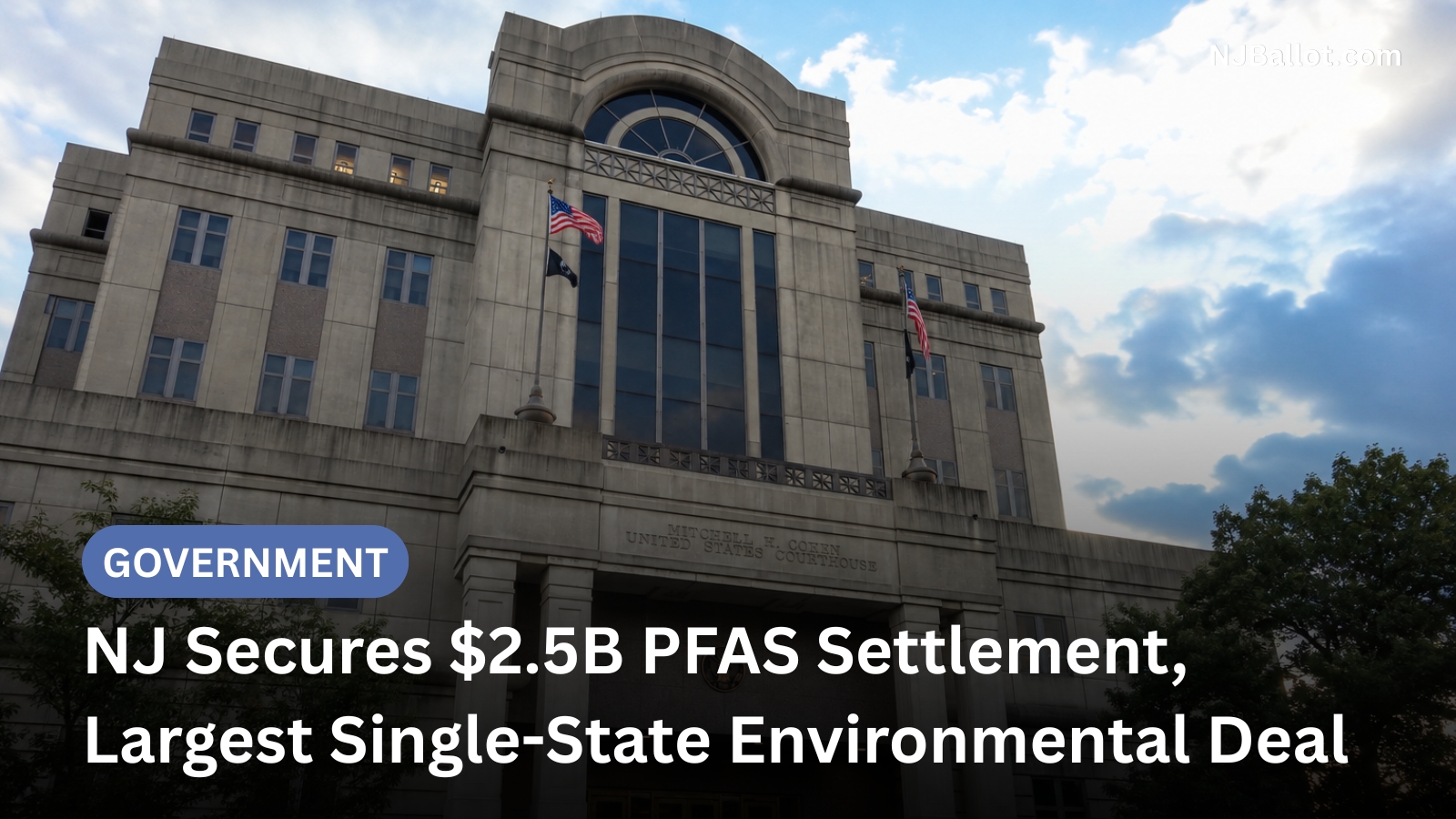
Two PFAS settlements worth approximately $2.5 billion won final approval Friday from Chief Judge Renee Marie Bumb in Camden. DuPont and related defendants will pay the sums. The group includes EIDP Inc. — the former E.I. du Pont de Nemours — plus the current DuPont de Nemours Inc., DuPont Specialty Products USA LLC, and two companies DuPont spun off in 2015: The Chemours Company and Corteva Inc. 3M, which supplied PFAS chemicals to DuPont, is also a defendant. The DuPont-related sum alone exceeds $2 billion. State officials describe the deal as "the largest environmental settlement ever achieved by a single state."
In 2025, the U.S. Environmental Protection Agency said it would pull back federal drinking-water standards covering four common PFAS compounds and push compliance deadlines for PFOA and PFOS out to 2031. States could either draft their own standards or walk away from enforcement. New Jersey did neither, with the state Department of Environmental Protection (DEP) maintaining its Statewide PFAS Directive.
The case was filed in the U.S. District Court for the District of New Jersey in 2019. The ruling, seven years later, binds defendants to a 25-year payment schedule. The cash will abate contamination statewide, restore natural resources at four specific industrial sites, and fund remediation work that the companies are legally required to complete regardless of final cost.
PFAS molecules resist biological breakdown. The New Jersey Department of Environmental Protection and the New Jersey Office of Attorney General note that federal regulators classify them as "likely carcinogens," and studies show exposure "may cause kidney, liver, and testicular cancer, as well as autoimmune and endocrine disorders in adults." The agencies also state the chemicals have been linked to "developmental issues affecting fetuses during pregnancy and infants who breastfeed," and children absorb them at higher rates relative to body weight.
DuPont and its predecessors manufactured explosives at four locations starting in the late 1800s. Pompton Lakes Works in Pompton Lakes and Wanaque, Passaic County, released lead and mercury during that period. The sites later expanded into chemical manufacturing, which is when PFAS entered the soil and water. The Repauno site in Greenwich Township, Gloucester County, lies on the Delaware River waterfront. The Parlin site in Sayreville, Middlesex County, sits between the Garden State Parkway and the Raritan River; it still operates today. Chambers Works in Pennsville and Carneys Point Township, Salem County, also still runs.
New Jersey sets its maximum contaminant level for PFOA, a common PFAS invented by 3M in 1947, at 14 parts per trillion. Residential wells near Chambers Works have tested above that threshold for years.
State deal more than five times larger than a separate federal settlement
On June 24, 2026, the U.S. Department of Justice and the U.S. Environmental Protection Agency announced a separate $450 million federal settlement with Chemours covering West Virginia, North Carolina and New Jersey. That deal operates under the Clean Water Act, the Resource Conservation and Recovery Act and the Toxic Substances Control Act.
New Jersey filed its own suit in federal court in 2019 and consolidated the case before Chief Judge Bumb. The Department of Environmental Protection reached proposed settlements with 3M in May 2025 and the DuPont entities in August 2025, then posted notices in the New Jersey Register and opened a 60-day public comment period. The department answered every submission and asked the court to approve the deal in late 2025.
Eighteen counties and publicly owned wastewater utilities objected after that motion — they wanted dedicated cleanup money for county fire academies and airports, and liability shields for utilities. The state negotiated a resolution by June 2, 2026, clearing the way for the judge's approval.
Attorney General Jennifer Davenport and NJDEP Acting Commissioner Ed Potosnak announced the approval on behalf of the Sherrill administration.
"For years, corporate polluters have profited from 'forever chemicals' while causing untold damage to our communities—endangering the health of our kids, contaminating the water we drink, and exposing our first responders to dangerous carcinogens," Davenport said in her statement. "Today's landmark settlement cements New Jersey's national leadership in the fight against forever chemicals and is a critical first step in undoing the damage DuPont and 3M have caused to our state."
Potosnak agreed. "This is truly a historic moment for New Jersey, which has experienced disproportionate and extensive pollution impacts from decades of PFAS manufacturing and use by DuPont and 3M. But this is only the beginning of what will be a long road to restore our environment from the unfortunate legacy of these chemicals," he said.
"The DEP and the Sherrill Administration are committed to engaging the public and our stakeholders to maximize the public health and environmental protection benefits of these funds to heal New Jersey."
The money will move through water bills and county ledgers
Settlement payments will arrive in annual installments over 25 years. The DuPont agreement includes $225 million for natural resource damages, $525 million for environmental abatement, and approximately $125 million for legal costs, penalties and punitive damages. The defendants also agreed to transfer roughly 73 acres near Ramapo State Forest to the state and to place conservation easements on three additional parcels totaling almost 1,400 acres.
The 3M settlement adds up to $450 million over the 25-year term. The first year brings $43.45 million for natural resource damages at Chambers Works and $16.55 million for abatement projects tied to that site. The money comes on top of roughly $300 million to $500 million that New Jersey water systems will receive under a separate nationwide public water system settlement 3M made in 2023.
The abatement pool alone will reach $795 million. That money will sit in dedicated trust accounts and flow through two channels, the PFAS Abatement Fund and the New Jersey Water Bank. The Department of Environmental Protection created the Abatement Fund as a non-lapsing account — money that cannot be diverted to other state purposes. The Water Bank issues loans for water quality projects. Borrowers will see interest-free, reduced-rate or principal-forgiven terms on loans that finance capital upgrades to filter PFAS from drinking water and publicly owned treatment works. At least $150 million of that pool is earmarked specifically for treatment works.
Counties and municipalities will also pull from the abatement pool. The Department of Environmental Protection set aside a minimum of $90 million for fire-training facilities owned by counties and for airports; both facility types used aqueous film-forming foam with PFAS for decades. Private well owners can also apply for remediation aid.
Natural resource damages will draw up to $365 million. That cash is restricted to restoring damaged land, water and wildlife near the four sites. Cities and residents can propose restoration projects through a portal managed by the Office of Natural Resource Restoration at the Department of Environmental Protection.
DuPont and the related defendants must set aside up to $1.2 billion for remediation and $475 million as a reserve. If one corporate defendant collapses, the reserve covers the shortfall and taxpayers owe nothing. The companies must clean all four sites completely, even if the price climbs past $1.2 billion. Legal fees and costs will consume roughly $195 million of the recovered cash.
The court approval on August 7 ends the litigation phase. The 25-year payment schedule begins now.
Related Articles
• Booker Criticizes Trump EPA’s Proposed Changes to PFAS Drinking Water Rules
• NJ Drought Warning Enters Fifth Month as Reservoir Recovery Stays Uneven
• NJ American Water Seeks $146M Hike as BPU Deadline Looms
Sources
• American Chemical Society, "Perfluorooctanoic Acid," Molecule of the Week (accessed August 8, 2026)
• DuPont de Nemours, Inc., press release, "DuPont Reaches Settlement Agreement with the State of New Jersey" (August 4, 2025)
• Inside Climate News, "Amid Federal PFAS Rollbacks, New Jersey Scores Record $2 Billion DuPont Settlement" (August 4, 2025)
• New Jersey Department of Environmental Protection, "3M PFAS Settlement," dep.nj.gov/3m
• New Jersey Department of Environmental Protection, "DuPont/Chemours PFAS Settlement," dep.nj.gov/dupont
• New Jersey Department of Environmental Protection and New Jersey Office of Attorney General, "Federal Court Approves Historic PFAS Settlements Valued at Approximately $2.5 Billion" (August 7, 2026)
• The Chemours Company, press release, "Chemours Reaches Settlement Agreement with the State of New Jersey" (August 4, 2025)
• Thomson Reuters, "New Jersey's $2.5 billion 'forever chemicals' settlements with DuPont, 3M, others win court approval" (August 7, 2026)
• U.S. Department of Justice, "United States and West Virginia Announce $450 Million Settlement with Chemours" (June 24, 2026)
• Waste360, "New Jersey Lands $2B PFAS Settlement From DuPont" (August 12, 2025)