
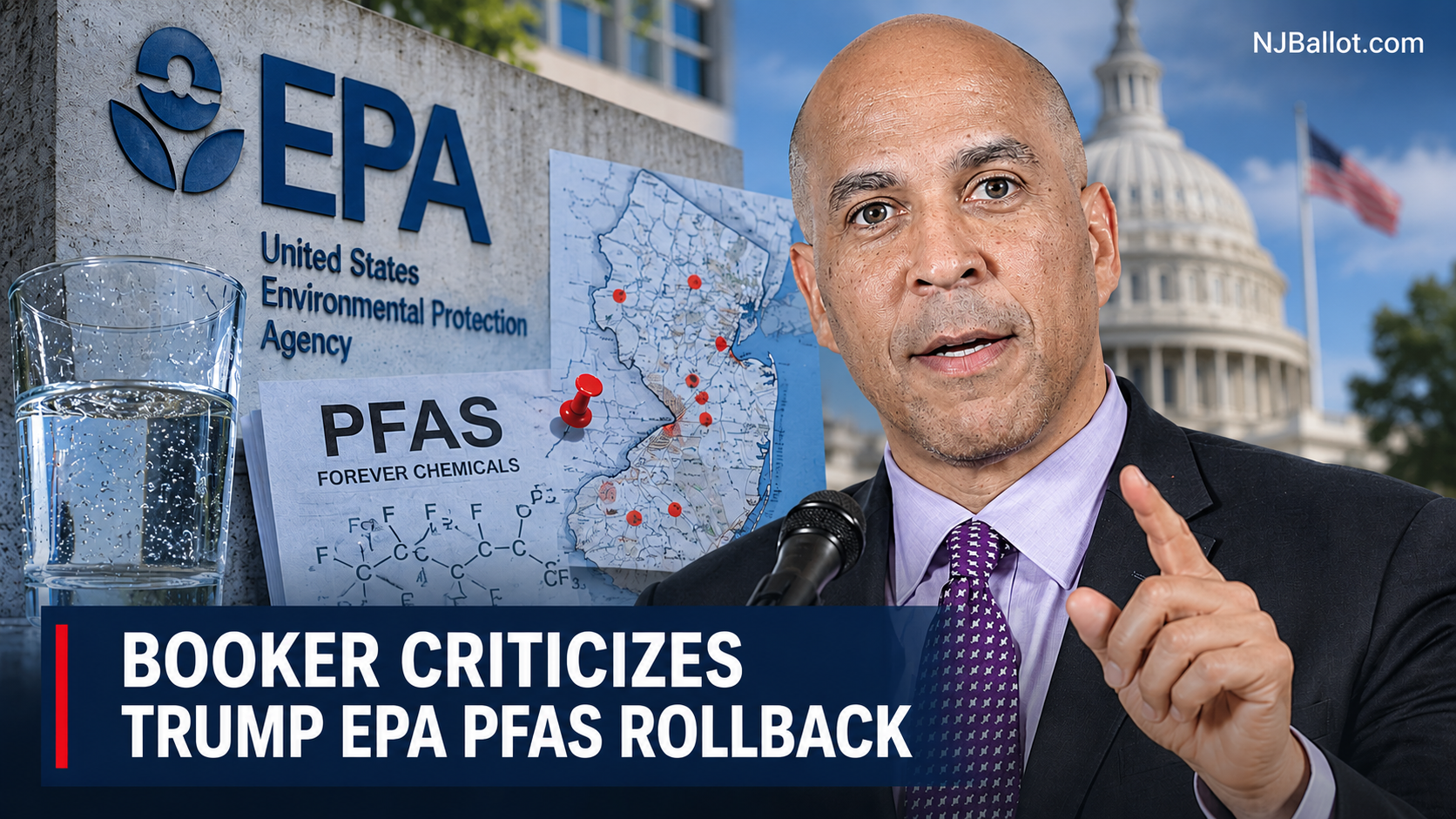

WASHINGTON, D.C. — U.S. Senator Cory Booker (D-NJ) is leading a social media campaign against the Trump administration’s latest environmental proposal: a move by the Environmental Protection Agency to revise drinking water protections for toxic “forever chemicals” that have been found in communities across New Jersey, including at the state’s largest military installation.
The EPA, led by Administrator Lee Zeldin, announced on May 18 that it is proposing to roll back limits on four PFAS compounds in drinking water. The agency also aims to delay compliance deadlines for utilities that opt into a new treatment framework.
The agency described the changes as “common-sense flexibility” for small and rural water systems. Environmental groups and Democratic lawmakers say the proposal weakens existing protections and could leave more people exposed to chemicals linked to cancer, immune dysfunction, and birth defects.
Booker, who chairs the Senate Democrats’ messaging operation, has used his social media accounts to criticize the rollback. In a May 20 post on X (formerly Twitter), he wrote: “The Trump EPA just gutted clean water protections so polluters can keep dumping forever chemicals into our drinking water. This isn’t deregulation — it’s endangerment.” The post had been viewed more than 1.5 million times as of May 21.
In an Instagram video posted the same day, Booker held up a map of New Jersey PFAS contamination sites and said: “Every single one of those dots is someone’s tap water. The administration is choosing corporate convenience over their health.”
The Senator’s focus on PFAS carries particular weight in New Jersey, where military bases, industrial sites, and suburban water systems have all documented elevated levels of the compounds.
The Trump EPA’s announcement targets a 2024 rule from the Biden administration that established the first-ever national drinking water limits for six PFAS compounds, including PFOA and PFOS. These chemicals were used for decades in firefighting foam, nonstick cookware, and industrial processes.
The new proposal would roll back enforceable limits on four PFAS compounds: PFHxS, PFNA, HFPO-DA (GenX), and a hazard index mixture that the Biden administration had regulated. It would also delay compliance deadlines for PFOA and PFOS from 2029 to 2031 for water systems that commit to treatment upgrades. Under the new proposal, states would receive $1 billion in new funding for PFAS treatment technology. A public hearing on the proposed changes is m scheduled for July 7, 2026.
In a statement, Zeldin defended the changes as necessary corrections to what he called “legally vulnerable” rules that “cut corners” and “failed to follow the Safe Drinking Water Act.” He described the revised approach as “gold-standard science” that would “follow the law and protect public health.”
Environmental advocates disagree. The Environmental Working Group called the move “likely illegal” under the Safe Drinking Water Act, which generally prevents regulators from weakening existing protections. The Environmental Defense Fund issued a sharp rebuke, with senior scientist Maria Doa stating: “There’s nothing gold-standard about tearing down science-based protections that millions of people are counting on.”
However, the Biden-era rule faced multiple legal challenges from water industry groups and some states, which argued the compliance costs, estimated in the billions nationally, would be especially hard on small systems. The Trump EPA’s proposal seeks to address those concerns while keeping some limits in place for PFOA and PFOS.
For New Jersey, the EPA’s proposed changes are far from abstract. The state has some of the highest documented PFAS contamination in the country, with exposure pathways that include industrial sites, military installations, and public water systems serving hundreds of thousands of residents.
At Joint Base McGuire-Dix-Lakehurst in Ocean County, PFAS contamination from historical firefighting foam use has created a cleanup challenge spanning years. In November 2025, Booker joined 27 Senate Democrats in calling on the Trump administration to speed up PFAS cleanups at military installations, specifically citing McGuire-Dix-Lakehurst as a site where remediation faces nearly a six-year delay under the current Department of Defense timetable.
That delay has left military families and nearby communities exposed to chemicals that the Centers for Disease Control and Prevention associates with increased risks of kidney and testicular cancers, thyroid disease, and developmental effects in children.
Beyond the military base, New Jersey has documented PFAS contamination at multiple Superfund sites and public water systems. The EPA has installed 108 Point of Entry Treatment systems and sampled more than 350 wells at the Route 31 Sludge Superfund Site in Washington Township, Warren County. In Paterson, the agency has used emergency authorities to address PFAS contamination while removing asbestos-contaminated structures.
New Jersey’s Department of Environmental Protection has historically taken a more aggressive stance than federal regulators on PFAS, implementing state-level standards that in some cases exceed the Biden-era EPA limits. Under the Trump EPA’s proposal, federal protections would fall below New Jersey’s existing state standards, a gap that could create complications for enforcement and cleanup efforts. However, state rules remain in effect regardless of what the EPA does.
The EPA’s proposal is not final. A public comment period is open until late June, with a hearing scheduled for July 7. The agency will review feedback before issuing a final rule, which is almost certain to face lawsuits regardless of which direction it goes.
For now, Booker’s social media feeds serve as the front line of his opposition, framing the PFAS debate not just as an environmental policy dispute but as a question of whether government will prioritize regulatory flexibility for industry over public health.
Sources
• U.S. Environmental Protection Agency, "EPA Advances Comprehensive PFAS Strategy with Legally Defensible, Practical, Scientifically Sound Drinking Water Protections" (May 18, 2026)
• Michael Phillis, Associated Press, "Agency will move forward with plans to propose weakening some Biden-era PFAS limits, official says" (May 7, 2026)
• Environmental Defense Fund, "Trump EPA weakens national drinking water protections for toxic 'forever chemicals'" (May 18, 2026)
• Environmental Working Group, "Trump EPA guts landmark PFAS tap water protections, leaving millions at risk of harm" (May 18, 2026)
• U.S. Senator Cory Booker, "Booker, Gillibrand, Colleagues Demand Trump Administration Stop Stalling Toxic Chemical Cleanups, Protect Military Families and Nearby Communities" (November 19, 2025)
• Burgess Everett, Semafor, "How Cory Booker convinced his party to get extremely online" (July 25, 2025)
• U.S. Environmental Protection Agency, "Trump EPA Highlights Major Year One PFAS Actions to Combat Risks and Make America Healthy Again" (February 6, 2026)
• U.S. Senator Cory Booker, X post, "Once again, the Trump administration has chosen to stand with powerful corporations over the health and safety of the American people" (May 20, 2026)
• U.S. Senator Cory Booker, Instagram video post (May 20, 2026)