
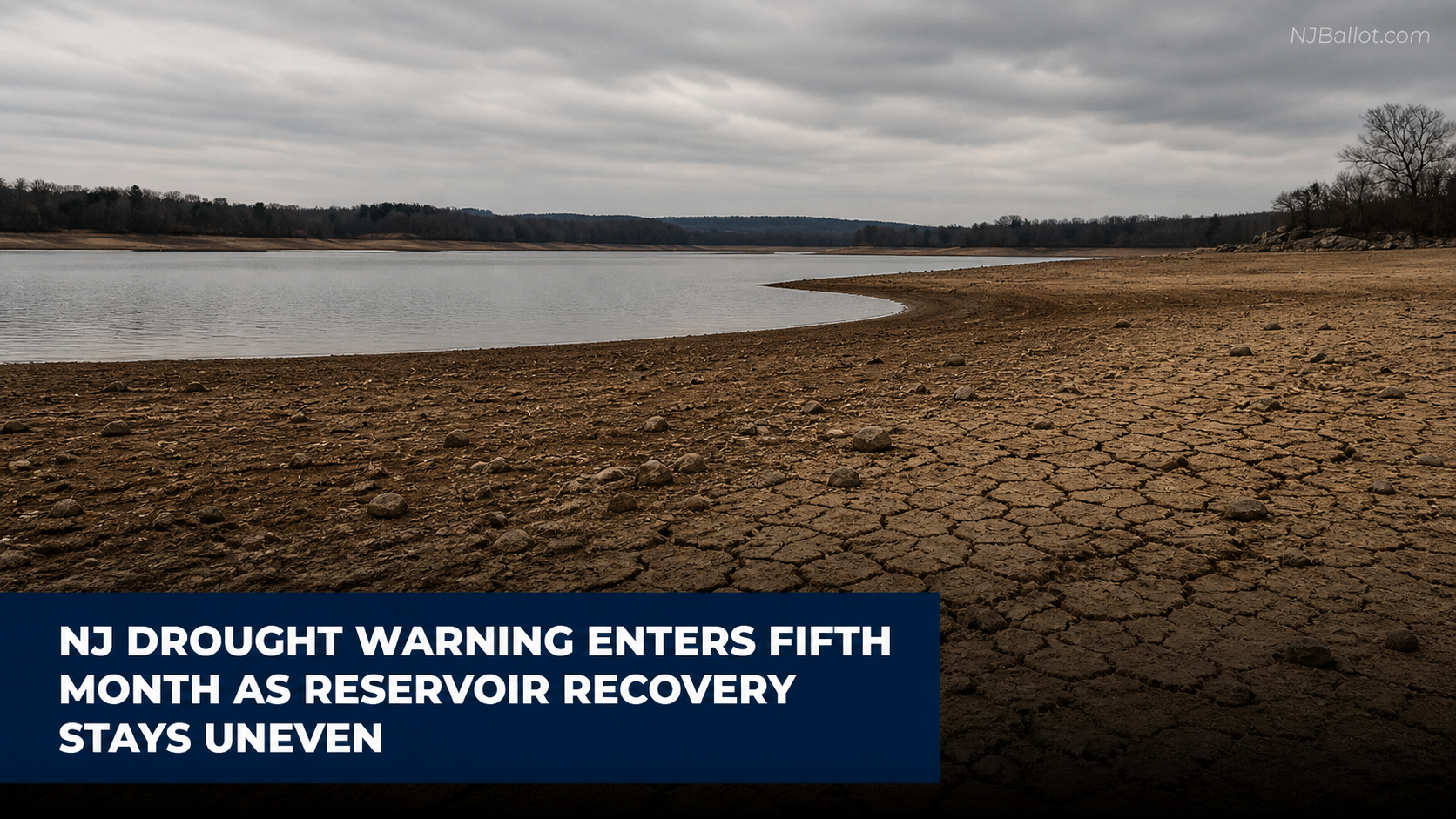

New Jersey enters its fifth month under statewide drought warning as reservoir systems show uneven recovery.
TRENTON, N.J. — Surface storage has gained ground in the north after winter snow, but groundwater and streamflow remain depleted statewide. Two municipalities have already enacted mandatory water restrictions while most residents still operate under voluntary state urging. The Department of Environmental Protection is relying on conservation appeals as summer lawn and irrigation demand approaches.
The Department of Environmental Protection issued formal Press Release 26/P020 on May 1, 2026 reaffirming the Drought Warning status they first declared on December 5, 2025. DEP urged residents to limit lawn watering to two days a week, take shorter showers and fix leaks. Governor Mikie Sherrill issued a statement supporting the advisory, warning: "While we saw a little relief over the winter, New Jersey is feeling the effects of nearly two years of below-normal precipitation... I urge everyone to join us in spreading awareness about the importance of conserving water."
The release notes eight consecutive months of below-normal rainfall, meaning the physical drought began roughly three months before the December 5, 2025 administrative declaration. DEP's May 1 release contains differing figures: the body notes 20 of the last 24 months as below normal, while State Climatologist David Robinson is quoted saying approximately 75% of the last 24 months. The discrepancy likely reflects different data windows or counting methods.
During the past 90 days, precipitation has been up to 4 inches below normal in parts of the state. All regions fall between 11 and 25 percent below normal precipitation over the past 180 days, with deficits reaching up to nearly 5 inches. DEP notes the Coastal South remains severely dry while northern systems improved after winter snow. Streamflow and groundwater remain well below normal, despite the relatively wet and snowy period in February and March. State Geologist Steven Domber provided technical assessments alongside Robinson for the advisory.
At Spruce Run Reservoir in Hunterdon County, the New Jersey Water Supply Authority recorded 61.2 percent capacity on May 1, with the gauge showing elevation at 260.39 feet and storage at 6.73 billion gallons. That marks recovery from the record low of 31.2 percent in December 2024, but it remains below normal operating levels. DEP advisories did not publish a specific capacity percentage for Round Valley, also in Hunterdon, in the May 1 release. The NJ Water Supply Authority lists the capacity calculation as pending due to pumping operations, a routine operational status that prevents real-time percentage reporting.
The Manasquan Reservoir in Monmouth County measured 94.30 percent capacity on April 29, with elevation at 101.84 feet and storage at 4.40 billion gallons against a historic April average of 97.86 percent, indicating near-full storage that nonetheless lags behind seasonal norms. The North Jersey District Water Supply Commission recorded Passaic County’s Wanaque Reservoir at 84.2 percent capacity on May 1, with elevation at 296.13 feet and storage at 24.94 billion gallons. That’s a significant recovery from the December 2025 system average of 45 percent, though DEP notes groundwater and streamflow remain depleted statewide.
While DEP urges voluntary conservation, at least two municipalities have enacted mandatory restrictions. Mount Olive Township in Morris County posted a formal notice effective April 13, 2026. Township records and WRNJ cite Code Article V, Section 318-32, which warns that violators face fines. The township code violations page confirms fines under Part 1, but the specific dollar amount was not available in public records reviewed. The township limits lawn watering to odd-even schedules based on address numbers, restricts watering to mornings and evenings and prohibits washing streets, sidewalks and driveways.
The Park Ridge Water Department, serving Park Ridge and Woodcliff Lake in Bergen County, enacted odd-even lawn watering from April 1 through September 1, 2026, citing reduced capacity from wells offline for treatment. Park Ridge restricts watering to mornings and evenings, prohibits washing pavement and vehicles and bars filling swimming pools. These divergent responses create a patchwork where some residents face enforceable rules while neighbors operate under purely voluntary urging.
The statutory framework splits authority. DEP classifies drought status under the Water Supply Management Act and can issue orders to water purveyors to manage supplies. But only the Governor can declare a Drought Emergency, which triggers mandatory restrictions on non-essential water use. The most recent such emergency lasted from March 2002 through January 2003, according to DEP records.
The drought warning connects to wildfire risk through a shortfall in prescribed burns. NJ Forest Fire Service Chief William Donnelly reported at an April 7 briefing that 201 wildfires had burned 154 acres statewide this year. Administrator Greg McLaughlin for Forests and Natural Lands confirmed only 8,600 acres of prescribed burns were completed over winter, against a normal target of 20,000 to 25,000 acres. McLaughlin called this the lowest treated acreage in approximately 25 years. The unburned fuel load entering peak wildfire season coincides with the active drought warning, as well as the April deployment of three engines and nine NJ Forest Fire Service firefighters to Georgia. The dynamic leaves fewer in-state resources available as peak season begins.
NJ Farm Bureau 2026 policy resolutions explicitly demand "exemption from water use fees and priority use during drought situations." DEP rules confirm agricultural irrigation remains exempt from Water Allocation Permit requirements under best management practices. No statewide agricultural impact assessment from the Department of Agriculture, Farm Bureau, or Rutgers extension has been issued for 2026.
Records from specific operations show localized stress: CBS Philadelphia reported on April 24 that John Hurff at Schober's Orchards in Monroeville lost peach buds to April frost and faces additional tree stress from dry conditions. Bill Exley at Exley's Christmas Tree Farm in South Jersey reports irrigating earlier than normal, and at higher cost, due to depleted soil moisture.
The Delaware River Basin Commission updated its drought information page April 6, showing that all New Jersey basin counties remain in drought warning while Pennsylvania holds four basin counties in warning and twelve in watch. New York and Delaware report normal conditions. A DRBC technical report released in January warned that the Trenton Flow Objective, which seeks to keep seawater from moving up the Delaware River, may not prevent salinity intrusion under combined drought and sea level rise conditions. The office reported that month that the salt front on the Delaware River sat at River Mile 85, noticeably farther upstream than average for the season. The position reflects low discharge rates from basin-wide dryness.
Three major water utilities pursue rate increases before the Board of Public Utilities during the drought warning. NJ American Water filed a $146.4 million base rate request in January 2026, citing infrastructure investment, lead service line replacement and PFAS treatment. Veolia Water New Jersey filed a rate review in December 2025, seeking adjustments to support $274 million in infrastructure investment. Aqua New Jersey filed a $6 million water and $1.87 million wastewater request in January 2026. The BPU has suspended all of these cases: American Water’s until June, Aqua’s until July and Veolia’s until September. Public docket summaries list infrastructure, lead service line replacement and PFAS treatment as the stated bases, with no mention of drought preparedness or conservation infrastructure.
DEP's weekly water supply updates continue through the Division of Water Supply and Geoscience. The agency posts advisories approximately weekly during active warning status. With summer lawn and irrigation demand approaching, the gap between voluntary appeals and mandatory enforcement will narrow if precipitation remains below normal. Municipal utilities with single-source dependence in the Northwest and Southwest regions face the greatest supply risk.
Whether the state repeats the 2002-2003 emergency precedent depends on rainfall through June. If precipitation remains below normal, reservoir and groundwater levels face renewed pressure and the Governor's exercise of statutory authority would determine whether mandatory restrictions take effect.
Related Articles
• NJ DEP Flood Rule Survives Sherrill Housing Push, Builders Squeeze
• The Flood Risk Cascade: New Jersey's $435.9 Billion Infrastructure Exposure
• Trenton Raises Water Rates as Wealthy Suburbs Sue to Take the System
• NJ Governor Sherrill Joins Three Multistate Alliances on Climate, Health, and Reproductive Care
• Wildfire Rages in Ocean County. Evacuations Ordered
Sources
• NJ Department of Environmental Protection, Press Release 26/P020, "DEP Urges Water Conservation as Drought Warning Continues" (May 1, 2026)
• NJ Water Supply Authority, "Spruce Run Reservoir Operations Data" (May 1, 2026)
• NJ Water Supply Authority, "Manasquan Reservoir Operations Data" (April 29, 2026)
• North Jersey District Water Supply Commission, "Wanaque Reservoir Daily Statistics" (May 1, 2026)
• NJ Water Supply Authority, "Round Valley Reservoir Operations Data" (April 30, 2026)
• Mount Olive Township, "Water Restrictions Are In Effect" (April 13, 2026)
• Mount Olive Township, Code Violations and Penalties (2026)
• WRNJ, "Mount Olive Township Water Restrictions" (April 14, 2026)
• Park Ridge Borough, Water Conservation Advisory (April 1, 2026)
• Trenton Water Works, System Status Update (March 6, 2026)
• NJ Forest Fire Service, Press Briefing (April 7, 2026)
• NJ Farm Bureau, 2026 Policy Resolutions (2026)
• NJ Department of Environmental Protection, N.J.A.C. 7:20A Agricultural Water Certification (2026)
• CBS Philadelphia, "NJ Farmers Face Drought and Frost" (April 24, 2026)
• Delaware River Basin Commission, Drought Information Update (April 6, 2026)
• Delaware River Basin Commission, "Sea Level Rise and Salinity Intrusion" (January 15, 2026)
• University of Delaware Center for Environmental Monitoring and Analysis, Delaware Climate Office Report (January 2026)
• NJ Board of Public Utilities, Order, NJ American Water Rate Increase Suspension (February 18, 2026)
• NJ Board of Public Utilities, Order, Veolia Water New Jersey Rate Increase Suspension (January 14, 2026)
• NJ Board of Public Utilities, Order, Aqua New Jersey Rate Increase Suspension (March 4, 2026)