
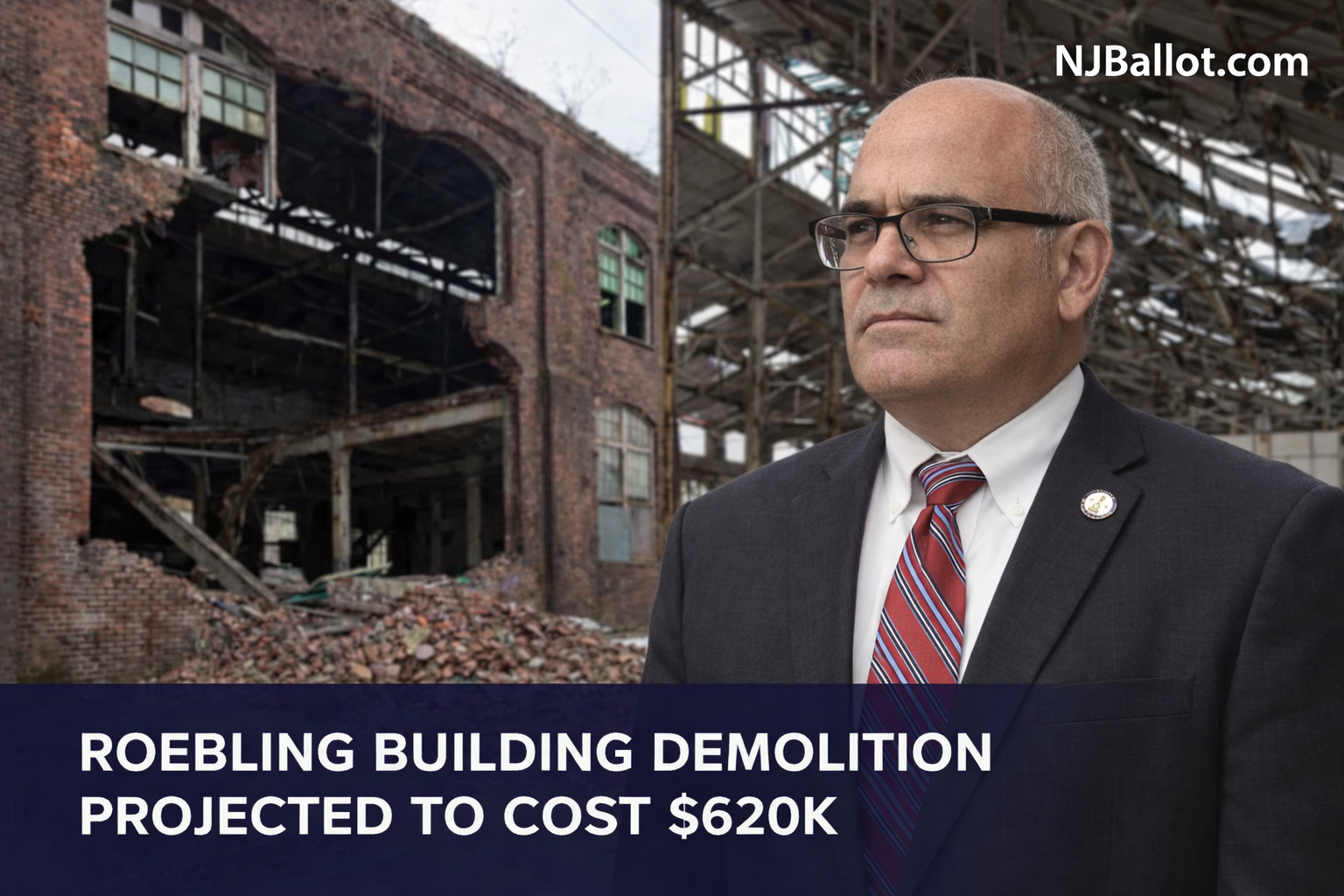

TRENTON—The demolition of Trenton’s historic Roebling Block 2 industrial structure will cost city taxpayers $620,000, according to Mayor Reed Gusciora and municipal officials. Carroll Demolition & Recycling secured the municipal contract to dismantle the 20,000- to 30,000-square-foot brick and steel building located in the Chambersburg section, after the vacant structure sustained a partial collapse in the early morning of March 7. Crews began dismantling the compromised structure last Thursday, after final engineering assessments concluded the brick facade posed imminent collapse risks to pedestrians and vehicles on adjacent roadways.
Inspectors from the Trenton Fire Department and city engineering division maintained a continuous security cordon around the unstable structure for five days following the incident, while they evaluated the integrity of the remaining walls. Municipal engineers determined that any attempt to stabilize the century-old brick and steel frame would exceed the cost of complete removal, given the extent of the structural compromise.
The $620,000 cost estimate remains preliminary, and additional project-related expenses may be incurred as the work proceeds, Gusciora stated in an email to NJBallot.com. He noted that the figure reflects demolition and debris removal specifically, without including potential soil testing or environmental remediation for heavy metals and industrial chemicals common in Trenton’s historic manufacturing facilities.
State Reimbursement and Developer Responsibility
City officials are actively pursuing reimbursement of eligible demolition costs through the New Jersey Department of Community Affairs. The department administers funding allocated for local government needs, including for emergency demolitions.
The mayor emphasized that the City bears responsibility for addressing the immediate hazard, rather than the development entity that currently holds site control. That redeveloper possesses site control solely for conducting environmental and structural due diligence and for proposing redevelopment plans, according to Gusciora's statement. That site control status does not confer responsibility for maintenance or stabilization of the existing structures. The entity has not detailed specific timelines in public records and the mayor did not identify the firm in his response to NJBallot.
2019 Rejection Led to Deterioration
Gusciora attributed the current emergency conditions to the Trenton City Council's rejection of a comprehensive redevelopment plan in 2019, early in his mayoralty. "That decision halted forward progress on stabilizing and redeveloping the property and contributed directly to the prolonged period of deterioration that has led to the current conditions," Gusciora wrote. The mayor noted it has taken several years to secure a new development partner capable of undertaking a project of this scale.
The Roebling complex traces its origins to the nineteenth century industrial empire of John A. Roebling who manufactured wire rope for suspension bridges like the Brooklyn Bridge at Trenton facilities. The Roebling Block 2 property stands near other historic industrial sites that have received substantial state preservation funding, including the Roebling Wire Works complex and the Eagle Tavern.
In earlier statements, Mayor Gusciora referenced a $7 million grant from the New Jersey Economic Development Authority for rehabilitating those adjacent historic structures; that funding does not apply to the Mott Street demolition site. While the $7 million NJEDA grant supports converting the South Broad Street Wire Works complex into modern commercial use, the Mott Street property lacked similar preservation funding, leading to its deterioration and eventual demolition rather than adaptive reuse.
Material Salvage and Environmental Policy
At this time there is no formal plan in place regarding the salvage or distribution of historic materials from the site. "We recognize the historical significance of the Roebling complex and appreciate the interest expressed by residents," Gusciora told NJBallot. "However any such effort would need to be evaluated in light of safety, storage and logistical constraints." State environmental regulations typically require additional testing for heavy metals and industrial chemicals before developers can commence new construction on former manufacturing sites.
Demolition work will continue for several weeks before crews complete the removal of all debris and clear the site, according to the mayor's stated timeline. Mott Street runs through the heart of the Chambersburg section, and neighborhood residents must navigate the one-way traffic pattern between Hudson Street and Clinton Avenue until crews clear the rubble and reopen the street to two-way vehicle traffic.
Trenton City Council authorized both the emergency demolition funding and the site control transfer in separate legislative actions that preceded the commencement of work. Once the site is clear, redevelopment can proceed with proposed plan proposals. City officials remain committed to advancing redevelopment of the Roebling site in ways that balance public safety with long-term economic revitalization.
Sources
• NJBallot, "Trenton Roebling Building Collapses, City Orders Demolition" (March 8, 2026)
• NJ.com, "Trenton crews to begin demolition of partially collapsed Roebling building" (March 7, 2026)
• NJ.com, "Trenton's Roebling Block 2 demolition will cost $620K. Here's what to know" (March 15, 2026)
• Email correspondence from Mayor Reed Gusciora and NJ.com coverage.