
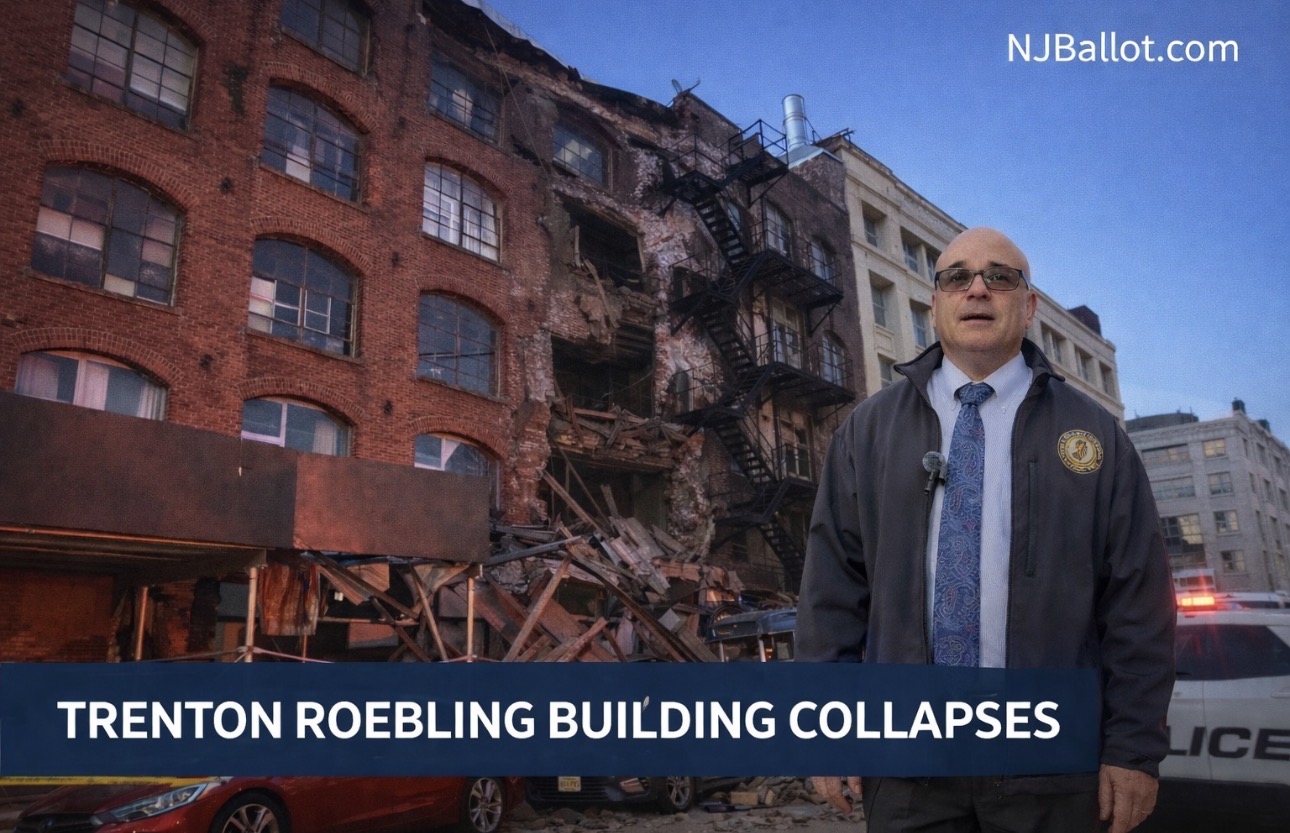

TRENTON—A century-old industrial building in the Chambersburg section will be demolished after an outer wall and second floor collapsed on March 1. Mayor Reed Gusciora announced the demolition order on March 6, after engineers determined the structure poses an imminent threat to residents, pedestrians and emergency responders.
The Trenton building sits on Roebling Block 2 in the Chambersburg section, a city-owned site that has sat dormant for years. The 7.5-acre property near the heart of the district has seen multiple attempts to attract developers.
Outer Wall Gives Way on Sunday
The collapse occurred at 6:45 a.m. on March 1, when the outer wall and second floor of Building 51 gave way without warning. Trenton Fire Department responded immediately to the incident at the Roebling Wire Works complex. One unoccupied vehicle sustained damage during the collapse.
No injuries were reported among residents or pedestrians in the immediate area surrounding the Chambersburg structure. Mott Street resident Gladys Carvajal told the Trentonian she felt "the earth move under her feet" when the wall came down on the otherwise quiet Sunday morning.
Engineers Declare Building 'No Longer Safe'
Built in 1897 with a 1911 addition, the two-story structure served as the Cold Rolled Products Office for the Roebling company during the height of Trenton's industrial dominance. It stands as a relic from the city's manufacturing past, when the John A. Roebling Wire Works anchored the local economy and employed thousands producing wire rope for bridges and elevators across the country, including the Brooklyn Bridge.
A 2017 assessment by the Cannon Group graded the 1897 building as "Poor" in condition and recommended continued monitoring of the deteriorating office building and its partial basement. City officials had previously identified the structure as unsafe prior to the March incident which confirmed that stabilization was no longer feasible or safe for workers attempting repairs.
Gusciora posted a video to Facebook on March 6, announcing the demolition and stating that engineers found the building "no longer safe and... structurally unsound." He called the loss "heartbreaking" and emphasized that "these historic industrial buildings are part of Trenton's story and whenever we lose one it's something that we take very seriously."
Demolition will proceed at the Roebling Block 2 site in the coming days to eliminate risks to Chambersburg pedestrians and emergency crews who might respond to future incidents at the unstable Trenton property. Engineers recommended full demolition rather than stabilization due to the severity of the structural failure and the potential for further collapse during any remediation work.
Brownfield Barriers Complicate Redevelopment
The Roebling Complex represents a significant chapter in New Jersey industrial history. Roebling produced cables for major suspension bridges and elevator systems during the 19th and early 20th centuries, including the Brooklyn Bridge. Its Trenton facility employed thousands of workers in the Chambersburg neighborhood, making the city a powerhouse of industrial output.
Decades of economic decline left many Trenton structures vacant, including Building 51, which has deteriorated significantly since the Roebling company's dominance of the wire rope industry.
Roebling Block 2 has been the subject of redevelopment efforts for years, as various city administrations sought to revitalize the dormant industrial parcel in the Chambersburg neighborhood. City Council has designated a redeveloper for the 7.5-acre parcel, though the identity has not been publicly disclosed.
Previous attempts have faced significant hurdles, including extensive environmental contamination from decades of heavy industrial wire rope manufacturing. A 2022 Trenton estimate placed soil remediation costs at $225,000 for the hotspot cleanup, technical reporting and institutional controls required before any Chambersburg construction could begin on the brownfield site.
That financial burden has complicated efforts by Trenton officials to attract viable development partners willing to assume the risks and costs associated with the Chambersburg property.
During demolition operations, Mott Street will become a one-way road from Hudson Street to Clinton Avenue to accommodate heavy equipment and protect workers and residents. Access to Mott Street will remain limited until the Trenton site is fully cleared and prepared for the next phase of Roebling Block 2 development.
City officials face mounting pressure to develop the prime Chambersburg real estate while grappling with the costs and risks associated with century-old buildings that have fallen into dangerous disrepair. Last Sunday's collapse highlights ongoing challenges as Trenton attempts to repurpose its industrial legacy while simultaneously managing aging infrastructure that threatens nearby neighborhoods.
Sources
• NJ.com
• Peterson's Breaking News
• The Trentonian
• City of Trenton RFP Documents
• Policy Commons
• Trenton Orbit (Facebook)