
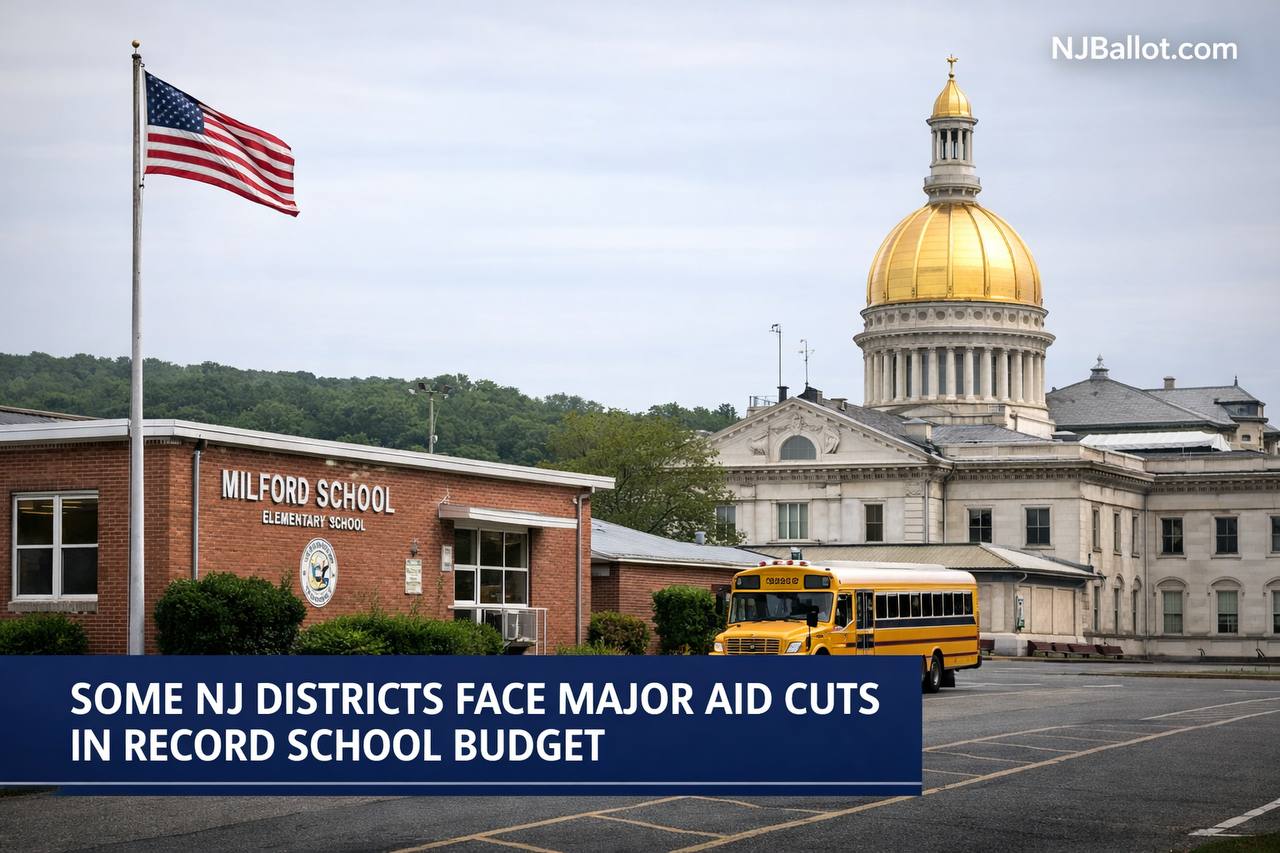

TRENTON —Milford Borough has one building and 80 students. Next year it will lose 61,584 in state aid. That is 770 per student gone from a budget that has no room to spare. The cut represents 17.76% of the district's state support, the largest percentage loss in New Jersey.
The same budget proposal gives Newark Public Schools an additional 60.6 million. That is enough to hire roughly 600 teachers, or eight times the entire student body of Milford.
Governor Mikie Sherrill calls this a record investment in education. Both numbers are accurate. Neither helps the eight districts facing catastrophe.
Gina Winters, president of the Cherry Hill Board of Education, warned the Assembly Budget Committee on March 25 that districts face cumulative devastation. But it's not just there. Republican districts, Shore districts, North Jersey districts. Everybody is feeling these impacts in a state with over 600 school districts.
Winners and Losers in Sherrill's School Funding
Sherrill's 12.4 billion proposal maintains the largest nominal allocation in state history. It eliminates adjustment aid that has buffered districts since 2008 and shifts special education calculations from statewide averages to actual enrollment counts. The result is a redistribution that caps aid increases at 6% for some districts while allowing eight to exceed the statutory 3% cap on losses due to aid eliminations.
Milford is one of those eight, losing nearly 18% of its state funding. Englewood loses 12.91% while Seaside Heights in Ocean County drops 6.73%. Colts Neck in Monmouth County loses 5.40%, Delaware Township in Hunterdon County drops 4.66%, and Franklin Township (also Hunterdon) loses 3.74%. Lopatcong Township in Warren County loses 3.20%, and Wallkill Valley Regional rounds out the list with a similar percentage.
One hundred sixty-seven districts face exactly 3% or just-under-3% reductions. The remaining four hundred districts see increases.
It's not that nominal dollars are being cut so much as purchasing power is welding against inflation. The math creates a structural shift. Trenton sends record dollars to education overall. It also diverts substantial funding to property tax relief programs like ANCHOR and Stay NJ.
Additional costs add a further wrinkle. Dstricts spent 1.8 billion on transportation last year but the state reimbursed only 549 million. The gaps are filled with local property taxes, which are only increasing.
The Suburban Crunch
Cherry Hill shows the squeeze facing affluent Camden County suburbs. The district anticipated a 14.5 million deficit in March. By April 7 that gap grew to 29 million after health premiums were finalized.
District budget documents show that Cherry Hill should receive 27.7 million in effective aid, representing a 3% loss against the Governor's proposal. Board president Gina Winters testified that the district sustained the maximum state aid reduction.
But the district is planning for the worst. It faces a 10 million health insurance increase. That is roughly a 30% growth for certain plans, against a statewide average of 19.7%. Cherry Hill will cut approximately 70 positions including tenured teachers and paraprofessionals. It approved a 7.4% property tax increase anyway.
Montclair in Essex County faces a 20 million deficit, despite $22,000 average property tax bills. The district cut 151 positions and will close a middle school.
Haddonfield in Camden County adopted a 5.95% tax levy. Health costs rose 18%, below the statewide average but enough to force five paraprofessional layoffs. The district operates on a $51.7 million budget.
Middletown Township Public School District best demonstrates the trap. Last year the district imposed a 10.1% tax increase specifically to prevent school closures. This year it has 3% levy authority. But it is closing Leonardo and Navesink elementary schools anyway, despite the prior extraction
Why Some Districts Lose Out: The Formula
The statewide aid cuts stem from several factors that converge in the Governor's recent budget proposal. The fiscal year 2027 budget continues a technical change begun last year that uses district-specific enrollment data rather than statewide averages for special education aid calculations. It also eliminates adjustment aid that held districts harmless during the transition to the 2008 School Funding Reform Act. Both of those changes have undermined previously-stable sources of funding.
Reimbursement thresholds for extraordinary special education aid have remained frozen at $40,000 for public programs and $55,000 for private schools since 2008. Meanwhile, average special education costs reached 38,984 last year. Districts pay the difference, without corresponding state increases.
The Garden State Initiative, a conservative-leaning research organization, notes that 192 districts together receive $396 million above formula dictates, while 284 districts receive $383 million less due to caps.
The Education Law Center, which litigated the state's Abbott affordable housing cases, supports the proposal but urges permanent statutory fixes rather than annual budget modifications. The New Jersey Education Association supports the proposal. The union calls the 12.4 billion allocation a necessary first step.
Senator Declan O'Scanlon (R-13th District), the Republican budget officer, criticizes the caps. He argues that the budget overrides the formula to artificially limit aid increases for districts that have been shortchanged.
The Upshot
No legislative committee has voted on the funding formula changes at time of writing. Assembly bills A2729 and A2877 remain in committee. The constitutional deadline is June 30.
The proposal shifts fiscal obligation from state income taxes to local property taxes, while maintaining a 2% local tax cap. Milford cannot absorb a 17.76% state aid cut without supermajority voter approval to override its cap. Its total state aid will drop to $285,141, while Newark will gain $60.6 million.
That is the formula.
Sources
• New Jersey Department of Education, "Examination of School Funding Policies Pursuant to FY2026 Budget Resolution 1378" (December 1, 2025)
• Mikie Sherrill, "Governor Sherrill Fiscal Year 2027 Budget Address" (March 10, 2026)
• New Jersey Department of Education, "Governor Sherrill Announces Over 12.4 Billion in K-12 School Aid for the 2026-27 School Year" (March 12, 2026)
• Cherry Hill Public Schools, "2026-2027 Tentative Budget Overview" (March 19, 2026)
• Cherry Hill Public Schools, "Budget Clarity Hub: Fiscal Year 2027" (April 7, 2026)
• New Jersey Department of the Treasury, "AON Releases Recommended Rate Increases for State Health Benefits Plans for Plan Year 2026" (July 9, 2025)
• Gina Winters, testimony before the New Jersey Assembly Budget Committee (March 25, 2026)
• Education Law Center, "Breaking Down School Funding in Governor Sherrill's Proposed FY27 Budget" (April 9, 2026)
• NJEA, "NJEA Statement on Gov. Sherrill's Budget Address" (March 10, 2026)
• Declan O'Scanlon, "Sen. O’Scanlon: State Budget Again Outrageously & Unfairly Totally Screws Many School Districts Out of Their Fair Share of State Funding" (March 12, 2026)
• NJ.com, "These 25 N.J. school districts will see the biggest state aid cuts next year" (March 25, 2026)
• NJ.com, "One of N.J.'s largest school districts is facing dire budget crisis, possible layoffs" (March 26, 2026).
• My Central Jersey, "Winners and losers in Central Jersey school funding for 2026" (March 12, 2026)
• New Jersey Department of the Treasury, "Budget in Brief: Fiscal Year 2027" (2026)