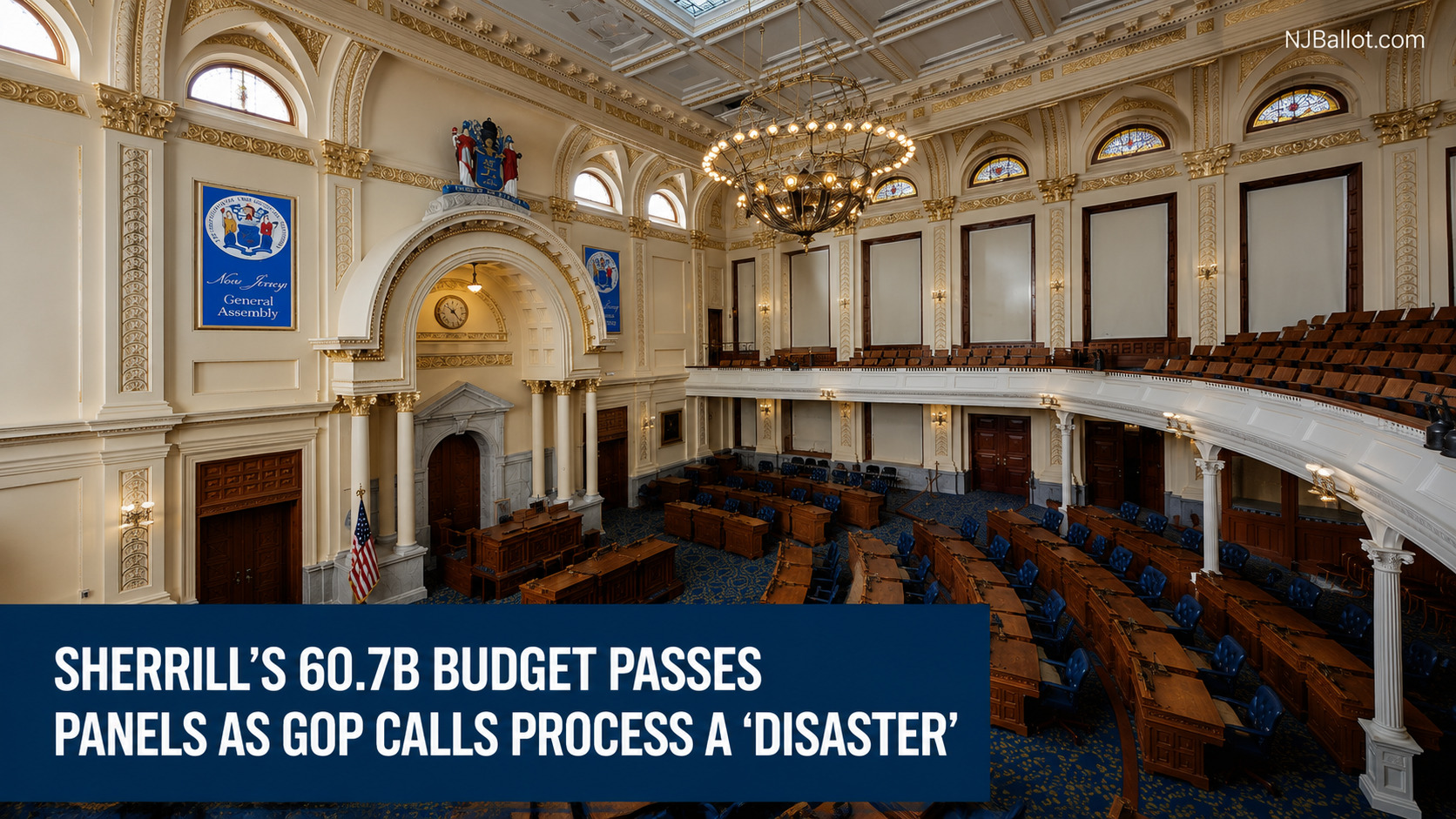

Senate President Nicholas Scutari and Assembly Speaker Craig Coughlin negotiated the $60.7 billion plan with Governor Mikie Sherrill. GOP budget officer Declan O'Scanlon says neither of them knew what was in it.
At 7 p.m. on June 28, the Senate Budget Committee convened with folders most members had opened for the first time 15 minutes earlier. Senate GOP Budget Officer Declan O'Scanlon (R, 13th District) flipped through 56 pages of line items. "As far as transparency goes, it's a disaster," he told InsiderNJ. "No one has a clue about what's in this budget, not even Nick Scutari or Craig Coughlin."
O'Scanlon voted no. So did every other Republican on the panel.
Three hours later, the committee voted along party lines to advance Governor Mikie Sherrill's first spending plan, a $60.743 billion package that her office says cuts the structural deficit roughly in half and delivers record property tax relief. Democrats control 57 of 80 Assembly seats and 24 of 40 Senate seats, and Republican opposition cannot override the Democratic majority.
But O'Scanlon and his Republican colleagues said the vote moved too fast for anyone to read the bill. O'Scanlon said the public "is the only one who really counts, and the public will have no opportunity" to examine the budget's details before voting. He warned that "there will be pork in this budget" and that the administration "must not ignore broken pledges and promises."
A June 24 joint statement from GOP Senators O'Scanlon, Michael Testa, Doug Steinhardt and Carmen Amato Jr. said the process "treats fairness, transparency and taxpayers as an afterthought" and that "everything is being negotiated behind closed doors." At the committee meeting, O'Scanlon pressed for a one- or two-week review period so lawmakers, the press and the public could read the bill before voting.
Sherrill launched the New Jersey Report Card on April 23, calling it a "gold standard" for accountability. The dashboard displays historical spending trends and department-level breakdowns across broad categories. Sherrill’s office updated the site on June 29, with the final $60.74 billion total and a comparison between her March proposal and the committee-approved version. But it still does not break down how each state department spends its funds below broad categories, and it lacks detail on individual legislative additions or program-level spending. Sherrill's first detailed budget runs 618 pages.
Lawmakers saw the FY2027 spending bill for the first time on June 28, only hours before their committees were scheduled to vote. The Assembly panel opened its session at 4 p.m.; the Senate followed at 7 p.m. O'Scanlon told InsiderNJ that members received 56 pages of line items 15 minutes before the Senate panel convened. No witnesses testified before the Senate committee.
The majority offices defended the process. Senator Paul Sarlo (D, 36th District), who chairs the Senate Budget and Appropriations Committee, told members the spending plan contained plenty to support. "There's a lot of good," he said. "There's things that each and every one of us don't like." Assemblywoman Eliana Pintor Marin (D, 29th District), who leads the Assembly Budget Committee, said "there's good things in this budget for everyone" and pointed to the narrowed deficit. Senator John Burzichelli (D, 3rd District) dismissed the GOP critique, saying anyone who thinks the budget lacks transparency is "not paying attention to the process." Democratic leaders said hearings in both chambers and across departments had aired the plan's contents well before the final vote.
The administration projects the structural deficit will drop from $3 billion to under $1.5 billion. State Treasurer Aaron Binder told the Senate Budget Committee on May 19 that policymakers had shaved another $200 million off that gap and pushed the surplus toward $6 billion. The FY2027 Budget in Brief, published by the New Jersey Department of the Treasury, forecasts $59.1 billion in revenue against $60.7 billion in spending. Surplus funds and non-recurring revenue fill the gap.
Lawmakers found $288.2 million more revenue than they expected when they wrote the March proposal. The windfall pushed the projected year-end surplus up by nearly $663 million, landing at $6.49 billion. Income taxes accounted for most of the extra cash. The Gross Income Tax beat estimates by $174.7 million, the Business Alternative Income Tax by $65 million, and the Insurance Premium Tax by $50 million. But sales tax and investment earnings both came up short, missing projections by $64 million and $47 million, respectively. Committees also advanced bills that would raise business taxes and fees by $750 million annually, including a per-employee Medicaid charge likely to face court challenges.
Lawmakers used the extra cash to restore spending items Sherrill had cut from her March plan. The final bill lands at $60.743 billion, roughly $15 million higher than her original proposal. The money flows to local fire departments, parks, libraries and rescue squads across the state, plus road and sewer projects.
Among state agencies, Community Affairs saw the biggest boost above Sherrill's request, gaining $112.9 million more. Several other departments saw smaller increases, while Human Services and Education absorbed the largest cuts, $253.2 million and $21.4 million respectively from the proposal in March.
The restored money includes a $30 million expansion of student support services and a $10 million increase for homelessness response. Rental assistance rises by $6 million, and the New Jersey Re-entry Corporation also sees new funding. The Working Class Families State Supplement climbs $3 million.
Local aid threads through the final bill in ways that benefit specific places. Jersey City collects $15 million for daily operations, while Camden County takes $9 million to acquire and demolish property. North Bergen, Lakewood, Sayreville and Carteret each land between $1 million and $1.6 million for parks, police stations and operating costs. Fire departments, libraries and rescue squads across the state also draw smaller slices.
Lawmakers also passed a separate bill carrying about $359 million in supplemental spending — what critics call "pork" — for the current fiscal year. Among the spending, Jersey City received $105 million in loans. The city was considering tax hikes of over 20 percent to close a $255 million budget hole, but the funding and other state aid let Mayor James Solomon reduce that figure to 15 percent. Other supplemental spending went to the New Jersey Sports and Exposition Authority, which received $40 million for World Cup events in East Rutherford. The bill also sends millions to recreation centers, athletic complexes and nonprofit groups.
Some spending lands in familiar places. Linden, where Senate President Scutari lives, collects $2.2 million in operating aid. Wood-Ridge, where Senator Paul Sarlo also serves as mayor, gets $5 million for a recreation center. East Rutherford and Rutherford each receive $1.25 million for parks; both projects have drawn state money in previous budgets Sarlo sponsored. In the FY2026 budget, approved in June of last year, more than 80 percent of legislative additions flowed to Democratic districts, according to NJ Spotlight News.
School District Health Costs Drove Some Hikes Anyway
Local tax levies in some school districts rose no matter which way state aid moved. Health-benefit costs drove the increases in each case. Haddon Heights lost 0.82 percent of its state aid this year but raised the local levy 6.93 percent. Health benefits alone added $1.2 million to expenses. Toms River Regional gained $1.79 million in state aid, capped at 6 percent growth. The district's tax levy still rose 4.9 percent, because health benefits jumped 13.3 percent to $6.57 million. Without that cap on aid, the district's levy would have risen just 1.4 percent, according to district budget documents.
Little Egg Harbor saw state aid climb to $8.58 million after years of cuts from Trenton. The board still approved a 2 percent increase in the tax levy. Employee health benefits in the district jumped 32.7 percent this year, building on a 50.7 percent increase across the previous two years.
Stay NJ Still Cut Back
The budget shrinks Stay NJ, the property tax relief program that Coughlin pushed through the Legislature in 2023 and that began issuing benefits this year. The deal drops the income ceiling for eligibility from $500,000 to $200,000, and applies benefit tiers based on income. Earlier reports and some administration statements referenced a $250,000 cap; the final agreement settled at $200,000.
Seniors earning $100,000 or less receive a tax credit of $6,500; the benefit falls to $5,000 for those at $150,000 and $4,000 for those at $200,000. The changes drop the program's annual price tag from $1.2 billion to $742 million.
Both budget panels cleared the spending plan on June 28, with every Republican voting no. The full Legislature passed the bill June 30, shortly before the July 1 constitutional deadline. Sherrill closed her first budget cycle with a surplus near $6.49 billion, a deficit below $1.5 billion and a Republican minority convinced that the process itself caused the real damage.
Related Articles
• NJ Budget Crunch: StayNJ Fight, CWA Rally and World Cup Collide in Trenton
• NJ Lawmakers Reach $60.7B Budget Deal, But the Bill Is Not Yet Seen
• NJ Republicans Refuse Budget Resolutions as Democrats Stay Silent
Sources
• Aaron Binder, testimony before Senate Budget Committee, New Jersey Department of the Treasury (May 19, 2026)
• David Wildstein, "Lawmakers unveil 60.74B budget with bigger surplus, hundreds of targeted spending additions," New Jersey Globe (June 28, 2026)
• Declan O'Scanlon, Michael Testa, Doug Steinhardt and Carmen Amato Jr., "Joint Statement on Budget Process," Senate Republican Office (June 24, 2026)
• Governor Mikie Sherrill, "Governor Sherrill Launches New Jersey Report Card," Office of the Governor (April 23, 2026)
• Governor Mikie Sherrill, "Governor Sherrill Presents Fiscal Year 2027 Budget," Office of the Governor (March 10, 2026)
• Governor Mikie Sherrill, "Governor Sherrill Updates Budget Report Card Ahead of Full Legislature Vote on FY 2027 Budget," Office of the Governor (June 29, 2026)
• John Reitmeyer, "Earmarks flood Democratic strongholds. Can Sherrill cut off her party?" NJ Spotlight News (May 14, 2026)
• Katie Sobko, "NJ 2027 state budget, at 60.7 billion, advances in Trenton," NJHerald (June 28, 2026)
• Katie Sobko, "Trenton squeezes 358.811M in pork into supplemental spending bill," NorthJersey.com (June 29, 2026)
• Little Egg Harbor School District, "FINAL LEHSD Budget 2026-2027 Presentation," Little Egg Harbor School District (April 28, 2026)
• Max Pizarro, "O'Scanlon: Budget Process a Travesty," InsiderNJ (June 28, 2026)
• Mikie Sherrill, Nicholas Scutari and Craig Coughlin, "Joint Statement on FY2027 Budget Agreement," Office of the Governor (June 23, 2026)
• New Jersey Department of the Treasury, FY2027 Budget in Brief (2026)
• New Jersey Monitor, "NJ launches budget transparency portal" (April 23, 2026)
• Nikita Biryukov, "NJ budget committees approve 60.7B budget in late-night votes," New Jersey Monitor (June 29, 2026)
• Patch, "Lacey Passes School Budget After Debate Over Taxes And Staffing" (May 6, 2026)
• Patch, "Tax Increases In Toms River School District Under Tentative 2026-27 Budget" (March 20, 2026)
• The Retrospect, "Haddon Heights School Tax Levy Up 6.93% as State Aid Falls and Health Costs Add 1.2 Million" (March 25, 2026)