

Twenty-four year-old Gregory Young was walking in Budapest, Hungary, when a bus struck him in 2003. The crash put him in a coma for six months and paralyzed his right side. He emerged with a severe traumatic brain injury (TBI). His mother Barbara flew to Hungary and stayed at his bedside through months of intensive care before getting him back to New Jersey. The son who boarded the bus that morning never came home.
In the years after, she built a policy career. Young connected with the Brain Injury Alliance of New Jersey, joined the state's Advisory Council on Traumatic Brain Injury and became the only family member on the council. In 2022, she helped push New Jersey's first TBI Parity Bill into law, which raised Medicaid reimbursement rates for community residential services. BIANJ honored her this year as its 2026 Distinguished Champion for Advocacy.
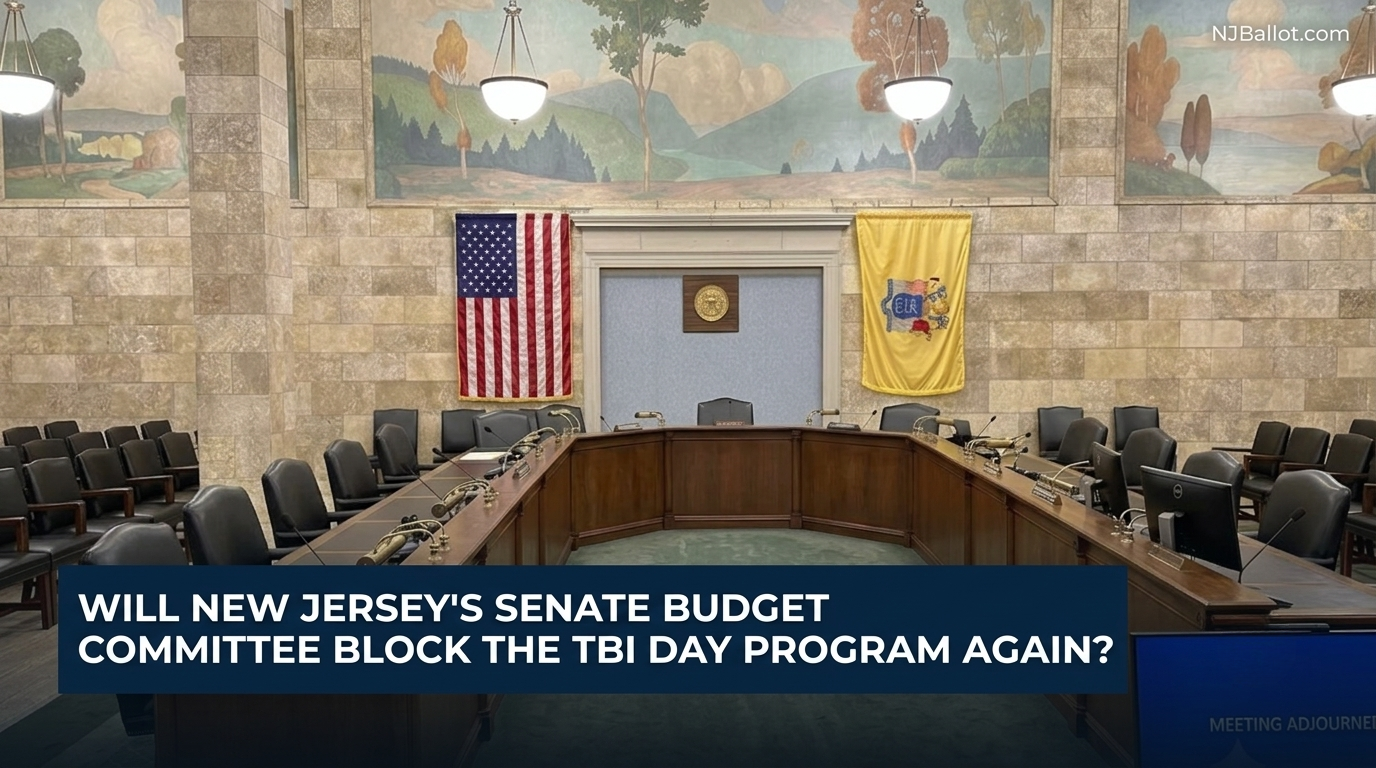
But the 2022 victory was incomplete. The Senate Budget and Appropriations Committee stripped structured day program services from the bill before it reached the governor's desk. Three years later, Young and a bipartisan coalition of twenty legislators are back with a narrower proposal than the original 2022 bill. It passed the Senate Health Committee unanimously on May 11. Senate Budget, the same committee that removed day programs in 2022, now holds the bill again. With no hearing scheduled as of June 22 and the constitutional budget deadline looming on June 30, seven days remain.
Senate Cut TBI Day Programs in 2022
Then-Senator Richard Codey and Senator Holly Schepisi introduced the 2022 TBI Parity Bill as S2049, which originally covered four service categories. It would have raised rates for community residential services across three supervision tiers and added structured day programs at $6.91 per fifteen minutes of service. The Office of Legislative Services estimated the full package would cost the state between $16.8 million and $20.5 million annually in gross Medicaid expenditures.
Senate Health, Human Services and Senior Citizens Committee passed it with technical amendments on March 10, 2022, leaving day programs intact. Senate Budget took it up on June 27, 2022, and removed the day program provision entirely. Committee members also lowered the residential tier benchmarks from C, D and E to B, C and the average of D and E. Lawmakers enacted P.L.2022, c.78 covering only residential services. After the amendments, cost estimates dropped to $9.1 million to $11.2 million.
That committee's official statement said the amendments removed the provision that would have tied brain injury day program rates to the Division of Developmental Disabilities' Tier D day habilitation benchmark. The statement also noted that the amendments lowered the minimum reimbursement rates for residential services below those in the original bill.
Advocates have spent the three years since trying to add that missing piece back.
Bill Would Raise Program Reimbursement Rates
Current legislation, S438 in the Senate and A4485 in the Assembly, amends P.L.2022, c.78 to add structured day program services as subsection (4). Medicaid reimbursement rates would rise from approximately $3.65 per fifteen minutes ($14.60 per hour) to the average of the Division of Developmental Disabilities' Tier D and Tier E Day Habilitation rates. According to the Office of Legislative Services fiscal estimate for the bill, that average is $9.89 per fifteen minutes, or $39.56 per hour.
One published report cited a figure of $93.96 per hour as the DDD benchmark. That number does not match any Day Habilitation tier in the official DDD fee schedule, where Tier E rates topped out at $44.52 per hour at FY2025 levels. The $93.96 figure may reflect a bundled or blended rate across multiple service categories. The $39.56 target represents a 171 percent increase over the current TBI rate, not the 543 percent implied by the $93.96 comparison.
The 2022 TBI Parity Bill's legislative findings noted that developmental disability rates had been restructured to account for acuity, minimum wage requirements and inflationary trends. Brain injury services never received that recalibration.
S438 would affect roughly 350 Medicaid beneficiaries with traumatic brain injuries who currently receive structured day program services. OLS estimates the gross annual cost at $6.8 million to $18.2 million, with a net state cost of $3.4 million to $9.1 million after the 50 percent federal Medicaid match. The net state cost of the TBI day program increase would be $3.4 million to $9.1 million annually, roughly 0.015 percent of Governor Mikie Sherrill’s proposed $60.7 billion budget for fiscal year 2027.
According to the OLS fiscal estimate, these services are reimbursed under the Medicaid Managed Long Term Services and Supports program, in which the state pays managed care organizations a monthly capitation rate per beneficiary. The estimate notes that any provider rate increase ultimately flows back to the state through higher capitation rates in the annual rate-setting process.
Twenty Legislators From Both Parties Sponsor Bill
S438 carries twenty sponsors, led by Senators Brian Stack and M. Teresa Ruiz, with co-sponsors from both parties including Senators Anthony Bucco, Holly Schepisi, Jon Bramnick and Troy Singleton. A4485, introduced by Assemblywoman Verlina Reynolds-Jackson and Assemblywoman Dawn Fantasia, has nine sponsors cross-party.
The Senate Health Committee passed it 7-0 on May 11; Senator Owen Henry did not vote. The Assembly Aging and Human Services Committee had advanced the companion bill on May 7.
Assemblywoman Fantasia, a Republican from the 24th District, told WRNJ Radio that the rate disparity jeopardizes continuity of care for the state's most vulnerable patients. "Even with the increase, it is more affordable for the state to provide services in the home and in the community, as opposed to a nursing facility," she said. "Not only would many patients prefer to be at home, but it also makes economic sense to preserve those services."
BIANJ testified before both committees, providing the estimate of 350 current beneficiaries. BIANJ records show structured day programs have gone without a rate increase for more than three decades.
Records show no official position from Governor Sherrill’s administration. Human Services Commissioner Stephen Cha's FY2027 budget testimony before the Assembly Budget Committee on May 4 runs fourteen pages. It covers H.R.1 Medicaid cuts, SNAP changes, child care assistance, a $154 million increase for the Division of Developmental Disabilities and long-term care services. It does not mention TBI, brain injury, structured day programs or this bill. OLS produced the S438 fiscal estimate without Executive Branch input, as it did for the 2022 S2049 estimates. The boilerplate language appears in both versions of the bill.
Bill Faces June 30 Budget Deadline
Senators referred the bill to the Budget and Appropriations Committee on May 11, the same day the Health Committee passed it. The budget committee's last regular meeting was June 4. No hearing for S438 appears on the public calendar as of June 22. New Jersey's constitutional deadline for the FY2027 budget is June 30, leaving seven days.
If the Senate Budget Committee does not act, legislators could carry the bill over to the next session, as its predecessor A4012 was in 2024. But advocates are pressing for action now. The rate they are fighting over, $14.60 per hour, has stayed frozen for more than thirty years, according to BIANJ.
Neuro Restorative, a national provider with twenty-six CARF-accredited facilities in New Jersey and its eastern regional headquarters in Delran, has campaigned publicly for the bill. Bancroft NeuroRehab, which operates therapeutic day programs in Mount Laurel, Plainsboro and Toms River, has not taken a public position. No organized opposition has emerged.
For Barbara Young, the question is whether the Senate Budget Committee will finish what it started in 2022, or whether her son's story and the stories of roughly 350 other New Jersey families will wait another year.
Related Articles
• Stack's Cyber-Harassment Bill Passes Senate While His Critic Faces Assault Charges in Another County
• Here Is What NJ Collected From Two CVS Medicaid Fraud Settlements, 18 Years Apart
• NJ Medicaid Fraud Recovery Is Real. The Math Behind It Is Brutal.
• NJ Republicans Refuse Budget Resolutions as Democrats Stay Silent
Sources
• Assembly Aging and Human Services Committee, New Jersey Legislature, Statement to Assembly Bill No. A-4485 (May 7, 2026).
• Bancroft NeuroRehab, Day Treatment Programs page (2026).
• Brain Injury Alliance of New Jersey, Barbara Young profile (2026).
• Brain Injury Alliance of New Jersey, 2026 Distinguished Champion for Advocacy Gala page (2026).
• Commission on Accreditation of Rehabilitation Facilities, Neuro Restorative New Jersey facilities accreditation records (2026).
• Garden State Initiative, "Medicaid Sustainability Report" (September 25, 2025).
• InsiderNJ, "TBI Reimbursement Bill" (June 17, 2026).
• Jay Edwards, WRNJ Radio, "Fantasia bill increasing Medicaid reimbursement rates for brain injury services advances" (May 8, 2026).
• New Jersey Department of Human Services, Division of Developmental Disabilities, FY2025 Cost-of-Living Adjustment Rate Guide (July 12, 2024).
• New Jersey Department of Human Services, Division of Disability Services, Traumatic Brain Injury Fund Annual Report, 2014.
• New Jersey Department of the Treasury, FY2027 Budget in Brief (March 2026).
• Office of Legislative Services, Legislative Fiscal Estimate for Assembly Bill No. A-4012 (July 2, 2024).
• Office of Legislative Services, Legislative Fiscal Estimate for Assembly Bill No. A-4485 (May 22, 2026).
• Office of Legislative Services, Legislative Fiscal Estimate for Senate Bill No. S-2049 [First Reprint] (March 22, 2022).
• Office of Legislative Services, Legislative Fiscal Estimate for Senate Bill No. S-2049 [Second Reprint] (July 5, 2022).
• Office of Legislative Services, Legislative Fiscal Estimate for Senate Bill No. S-438 (May 22, 2026).
• Senate Budget and Appropriations Committee, New Jersey Legislature, Statement to Senate Bill No. S-2049 [First Reprint] (June 27, 2022).
• Senate Health, Human Services and Senior Citizens Committee, New Jersey Legislature, Statement to Senate Bill No. S-438 (May 11, 2026).
• Stephen Cha, Commissioner, New Jersey Department of Human Services, Testimony before the Assembly Budget Committee (May 4, 2026).