
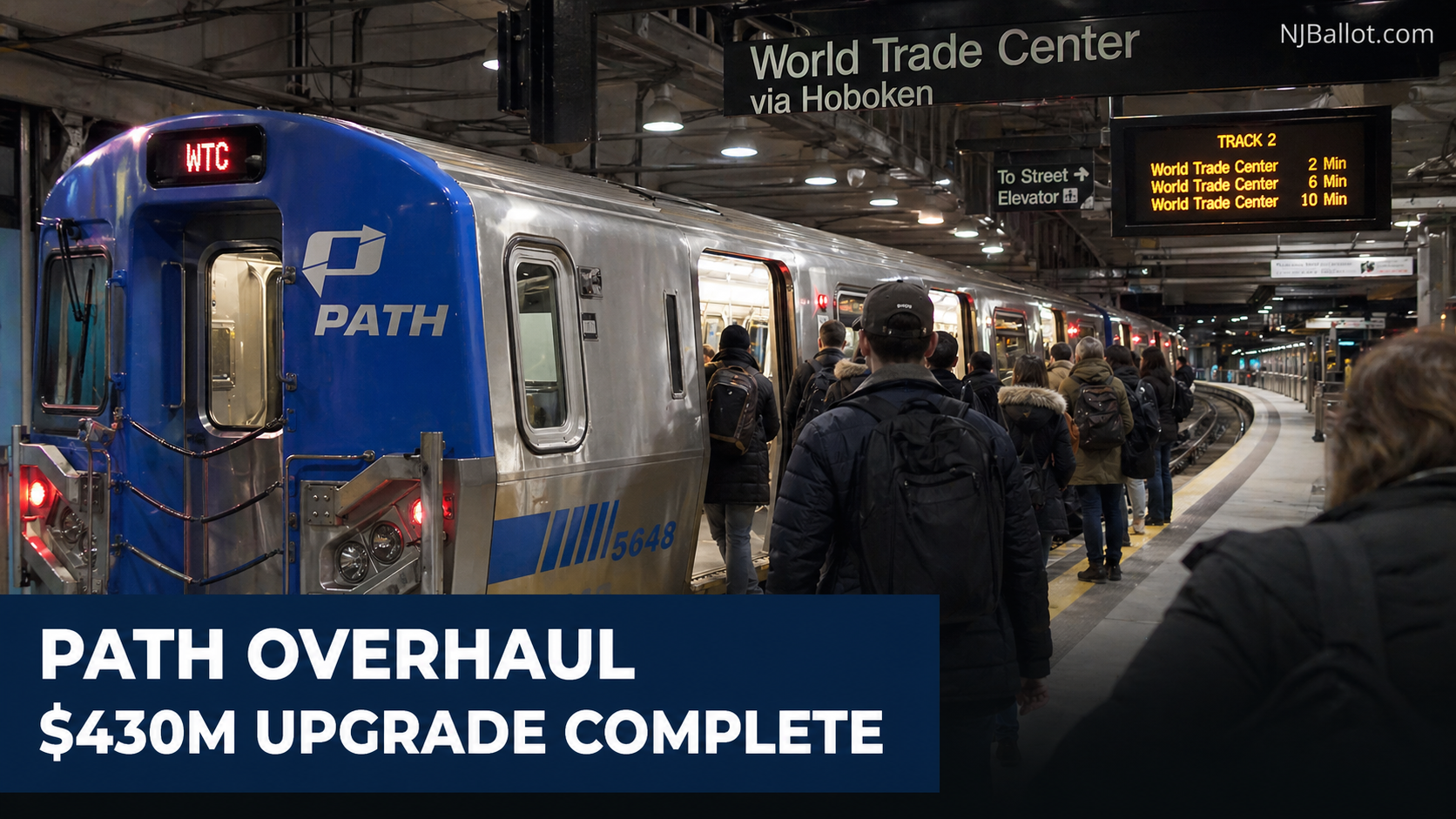

Port Authority finishes station rebuilds and track work, but an expired union contract and mayoral silence raise questions about who controls the system's future.
NEWARK, N.J. —The Port Authority finished its two-year, $430 million PATH Forward program in early 2026, according to board documents and NJ.com. Crews replaced track, rebuilt four stations, and added flood protection along the Passaic River. Riders now board 9-car trains on the Newark-to-World Trade Center line during rush hour, and peak headways on the Journal Square-to-33rd Street route have tightened to four minutes.
Weekend ridership has already surpassed pre-pandemic levels, with a single-day record of 246,594 passengers on November 20, 2025, according to Port Authority records.
The program touched every major Hudson County station. Hoboken got a $54 million overhaul, including new track switches and a rebuilt mezzanine. Grove Street in Jersey City received a $16.7 million upgrade, with its Vertical Platform Lift now operational for passengers who need step-free access. Exchange Place and Newport saw ADA-compliant stairway rebuilds and modernized concourses. Between Journal Square and Harrison, crews laid 6,000 feet of new track and built a sea wall to shield the line from Passaic River flooding.
Then-Hoboken MayorRavinder Bhalla thanked PATH and NJ Transit in February 2025 for coordinating the station closure and reopening on schedule.
Service increases began rolling out before the last scaffold came down. The Port Authority activated 9-car trains on the Newark line in October 2024 and trimmed peak headways on the JSQ-33 route the same month. By March 2026, weekend service on the JSQ-33 line doubled to every ten minutes. In May, Hoboken will regain direct weekend service to both the World Trade Center and 33rd Street for the first time since 2001. By March 2027, the Newark line will run every four minutes at rush hour, a 25% frequency bump that pushes 15 trains per hour through the tube.
Ridership numbers justify the spending, at least on paper. The system carried 60.7 million passengers in 2025, the first time it cleared 60 million since 2019. Average weekday ridership hit 198,401 last year, up 6.6% from 2024. In September 2024, the Port Authority recorded 206,543 average weekday riders, a 15% jump from September 2023.
Weekend riders have been the surprise growth engine. Saturday and Sunday volumes in November 2025 exceeded November 2019 levels by roughly 9%. Weekday traffic still lags 26% behind the pre-pandemic baseline.
But the infrastructure work has not eliminated all operational friction. One rider reported a 30-minute delay at Journal Square on March 20, 2026, caused by a track defect at the World Trade Center terminus, though the account could not be independently verified. Other riders have posted confusion about whether PATH Forward actually ended in April 2026 or will restart in October 2026, suggesting the Port Authority's communication about the program timeline has not reached the platform level.
The agency surveyed more than 1,000 riders in September 2025 and said respondents "consistently" requested expansion, but it has not released the survey methodology or raw results.
The labor picture remains publicly unreported. The contract covering 175 PATH track maintenance workers expired on September 9, 2025, and the union filed official notices at that time. At time of writing, no settlements have been announced. The Port Authority maintains twelve collective bargaining agreements with eleven PATH unions, several of them expiring by mid-2026.
The absence of a public announcement does not indicate active dispute; it indicates the Port Authority has not disclosed whether negotiations are active, stalled, or in mediation. The workers maintain the physical infrastructure that 198,000 weekday riders depend on.
Municipal officials who bear the political cost of PATH failures do not control the budget that fixes them. Then-Mayor Bhalla told Gothamist in July 2025 that the Port Authority "has routinely underfunded the PATH system" while pouring billions into airport terminals. He warned that a lower capital budget "increases the timeline for delays, increases the timeline for shutdowns on weekend service, and increases the intervals between trains."
Current Hoboken Mayor Emily Jabbour, who took office in January, campaigned on advocating with the Port Authority for improved PATH service on nights and weekends. But Jabbour has released no post-inauguration statement on the Forward program completion as of writing. Her first-year priorities, published in February 2026, focus on road repaving, public safety patrols, and expanding Hoboken's local Hop shuttle service, with no mention of PATH.
Jersey City Mayor James Solomon, who also took office in January, campaigned on a platform that included a dedicated seat for Jersey City on the Port Authority Board, direct weekend PATH expansion, and a route to Newark Airport. Records likewise show no post-election statement from his office on the Forward program completion as of late April 2026.
Newark Mayor Ras Baraka has not publicly commented on the infrastructure wrap-up. His recent transit statements have focused on airport access and homelessness initiatives at Penn Station.
The money that built PATH Forward does not come from fares. The system relies on cross-subsidies from airport and seaport revenue, not fares, to close its annual operating gap. The agency's new ten-year capital plan allocates $2.6 billion to PATH, but it also schedules fare hikes: a quarter-dollar increase this summer, then another quarter each January from 2027 through 2029. The hikes would push the base fare from $2.90 toward $4.00.
New fare gates equipped with AI and CCTV cameras for evasion detection are already rolling out. The Port Authority says the fare increases are a necessary investment. Riders, who have no competing rapid transit operator for the cross-Hudson corridor, will pay them regardless.
The program's physical legacy is concrete and steel: new track, rebuilt stairways, elevator access at all nine stations, a flood wall, and longer trains. Port Authority bid results identify J-Track LLC and Siemens Mobility Inc. as PATH contractors, but the full contractor roster and individual contract values for the $430 million program have not been publicly disclosed.
Its political legacy is less certain. A $430 million capital investment has restored capacity and pushed ridership upward, but it has not resolved who controls the system, who maintains it, or who pays when the next station closes.
Sources
Port Authority of NY & NJ, PATH Forward Program Page, April 2024
Port Authority of NY & NJ, 2026-2035 Capital Plan, November 2025
Port Authority of NY & NJ, Board Presentation, November 2025
Port Authority of NY & NJ, Press Release, October 2024
Port Authority of NY & NJ, Press Release, November 2025
Port Authority of NY & NJ, Press Release, February 2025
Port Authority of NY & NJ, Official Statistics, 2024-2026
Port Authority of NY & NJ, Accessibility Page, 2025
Port Authority of NY & NJ, Construction Awards, 2025
Port Authority of NY & NJ, Bid Results, 2024-2025
NJ.com, September 2025
NJ.com, April 2026
Metro Magazine, January 2026
Progressive Railroading, February 2026
CBS New York, November 2025
Gothamist, July 2025
Insider NJ, February 2025
Hoboken Girl, February 2025
Hoboken Girl, March 2026
HobokenNJ.gov, February 2026
New York Times, February 2026
Reddit r/jerseycity, March 2026
Reddit r/jerseycity, April 2026
Wikipedia / APTA, 2025
Emily Jabbour Campaign Website, 2025