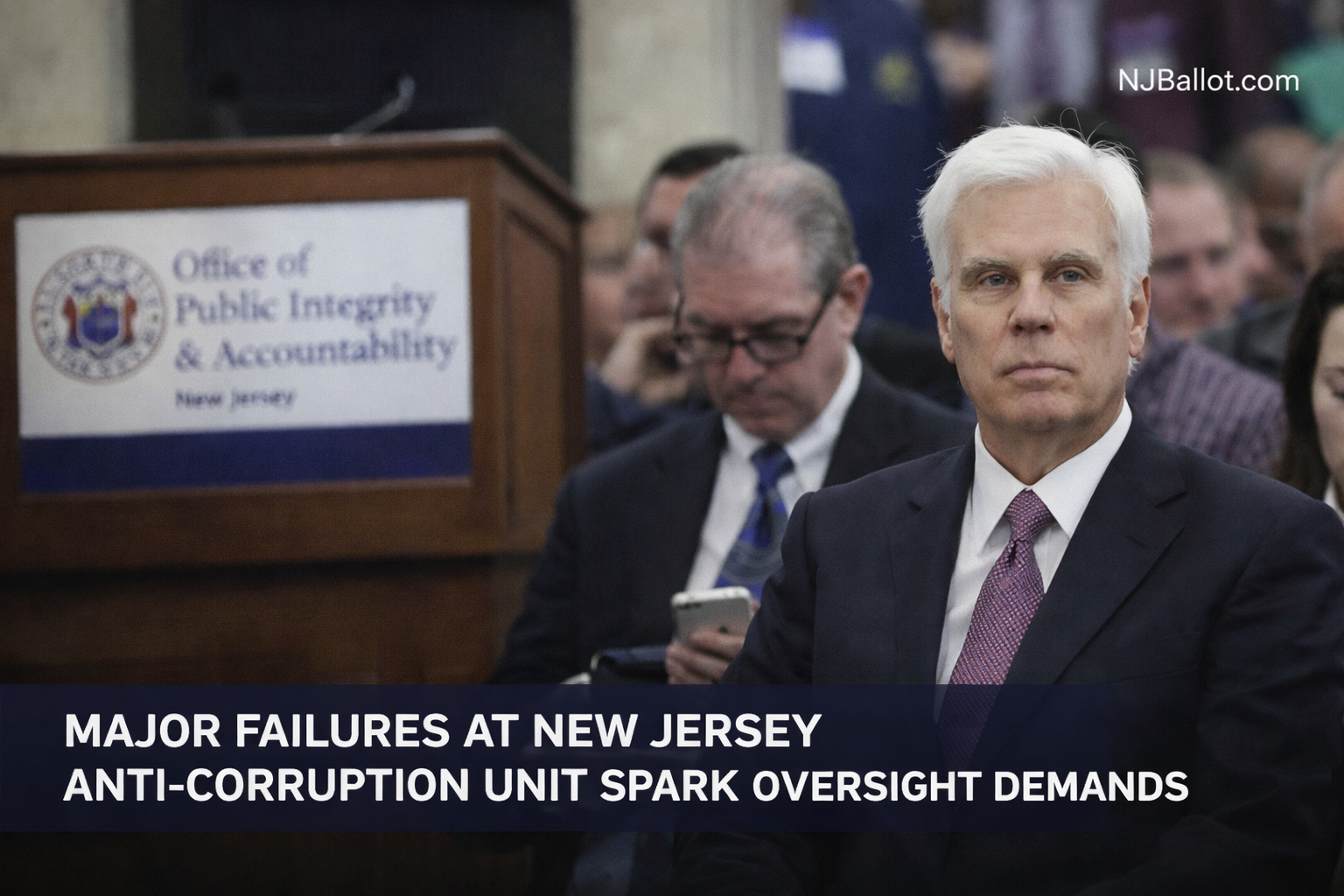
TRENTON—New Jersey's Office of Public Integrity and Accountability (OPIA), the state's premier anti-corruption prosecution unit, has recently come under fire and received demands for independent investigations. The calls came amid judicial findings of "prosecutorial mismanagement," Brady violations, and "unconstitutionally vague" charging documents.
The Pattern of Failure
OPIA, which was created in 2021 to consolidate public integrity enforcement under a single specialized division, has lost five major cases in two years. That includes the high-profile racketeering prosecution of political boss George Norcross III.
Over the past two years, OPIA has suffered dismissals in cases against:
• George Norcross III (February 2025): Judge Peter Warshaw dismissed racketeering charges against the political boss, citing speedy trial violations and "prosecutorial mismanagement"
• Edna Mahan Correctional Facility Employees (October 2025): Judge Christopher Garrenger dismissed charges against 10 officers accused of abusing transgender inmates. In a 60-page ruling that detailed systemic charging failures, he called OPIA's legal theory "unconstitutionally vague" and cited "prosecutorial mismanagement." Facility administrator Sean Kugler’s charges were also dropped.
• Rabbi Osher Eisemann (2024): Judge Joseph Paone dismissed money laundering charges against the prominent Lakewood religious leader, finding "prosecutorial mismanagement" and Brady violations. A Brady violation means that prosecutors failed to disclose evidence that would prove guilt or innocence. In this case, prosecutors failed to disclose 1,700 pages of exculpatory evidence including 57 recorded phone calls and 150 text messages.
• Unnamed Paterson Police Officer (2024): Case dismissed after OPIA failed to provide exculpatory evidence, part of a pattern of discovery failures
The dismissals span multiple jurisdictions—Mercer, Middlesex, Hunterdon, and Passaic counties—and involve both Republican-appointed and Democratic-appointed judges, suggesting the failures transcend partisan bias or individual judicial philosophy.
While OPIA reports 150+ "successful dispositions," these five dismissed cases represent the unit's highest-profile, most resource-intensive prosecutions. The Corruption Bureau's 12 prosecutors handle over 130 matters, meaning major case dismissals consume disproportionate capacity and undermine the deterrent effect of anti-corruption enforcement.
Resource Constraints and Capacity Collapse
OPIA has operated on a flat $2.3 million budget from FY2021 through FY2025, with what the TRUST Commission called only a "minor increase" in FY2026 despite expanding caseloads and mounting complexity. The Corruption Bureau’s 11:1 case-to-prosecutor ratio exceeds sustainable capacity and contributes to the procedural shortcuts documented in judicial rulings.
The TRUST Commission, chaired by former federal prosecutor Lee Vartan, explicitly noted OPIA that has been "under-resourced and under-staffed for years," creating conditions where prosecutors cannot meet discovery obligations or maintain case continuity.
Legislative and Public Response
In October 2025, Senate President Nicholas Scutari (D-Union), the highest-ranking legislative officer in the state, demanded an independent monitor to oversee OPIA, citing "serious concerns about the administration of justice" and the pattern of dismissals.
After the Eisemann case dismissal, Senator Joe Cryan (D-Union), a former Union County Sheriff with prosecutorial experience, introduced S3039 to mandate Brady training and stricter discovery protocols, recognizing that judicial findings of misconduct require structural response beyond internal review.
The NAACP and AFL-CIO filed a court challenge against OPIA in October 2025, arguing that the body lacks sufficient oversight. The groups asked the Appellate Division to appoint an independent monitor outside the Attorney General's authority. Their filing cited not only the case dismissals but also alleged evidence destruction by cooperating witness Matthew O'Donnell in a separate corruption case, suggesting OPIA's failures extend beyond mere resource constraints to active mismanagement of investigative integrity.
Executive Resistance and the TRUST Commission
Former Attorney General Matthew Platkin resisted external oversight. In October 2025, his office called the NAACP claims "baseless" and defended OPIA as "essential" to combating corruption. On January 7, 2026, Platkin released the TRUST Commission report, which recommended creating an Inspector General for OPIA—but under the Attorney General's authority, not as an independent entity. The Commission cited OPIA's 150+ "successful dispositions" as evidence of effectiveness, even as it acknowledged the unit has been "under-resourced." Jennifer Davenport, who succeeded Platkin as Attorney General, has not commented on the matter.
The TRUST Commission's refusal to recommend removing OPIA from AG oversight, despite cataloging systemic failures including the five major dismissals, suggests that the Attorney General’s office prioritized preserving executive chain-of-command over structural reform that might prevent future prosecutorial misconduct.
The Structural Conflict: Two Models of Accountability
The debate centers on contradictory definitions of "oversight" that reflect fundamentally different theories of institutional accountability. Legislative and civil society stakeholders demand an independent monitor outside the Attorney General's chain of command, effectively bypassing the executive branch to supervise prosecutorial conduct and ensure compliance with constitutional discovery obligations. This model treats OPIA's failures as symptoms of structural conflicts of interest inherent in self-policing: the Attorney General cannot objectively supervise prosecutors who report to the Attorney General.
The AG Office and TRUST Commission’s proposed model treats OPIA's failures as resource constraints and individual errors rather than systemic conflicts, suggesting that additional funding and internal quality control can restore functionality without threatening executive prerogative.
The conflict between "independent monitor" and "Inspector General under AG" is not semantic quibbling but a material contest over who controls the legitimate means of anti-corruption enforcement in New Jersey. The question ultimately determines whether accountability flows upward through democratic oversight or downward through executive hierarchy.
Sources
• NJ Globe (David Wildstein, Oct 2025)
• NJ Monitor (Brent Johnson, Oct 2025)
• Politico NJ (Ry Rivard, Oct 2025)
• NJ.com (Rebecca Everett, Oct 2025)
• WHYY (Oct 2025)
• NJOAG Press Release (Jan 7, 2026)
• NJ Monitor (January 2026)
• NJ FY2021 Budget
• NJ.com (2024)
• NJ Globe
For the latest New Jersey political news, breaking updates, and investigative reporting, visit NJBallot News