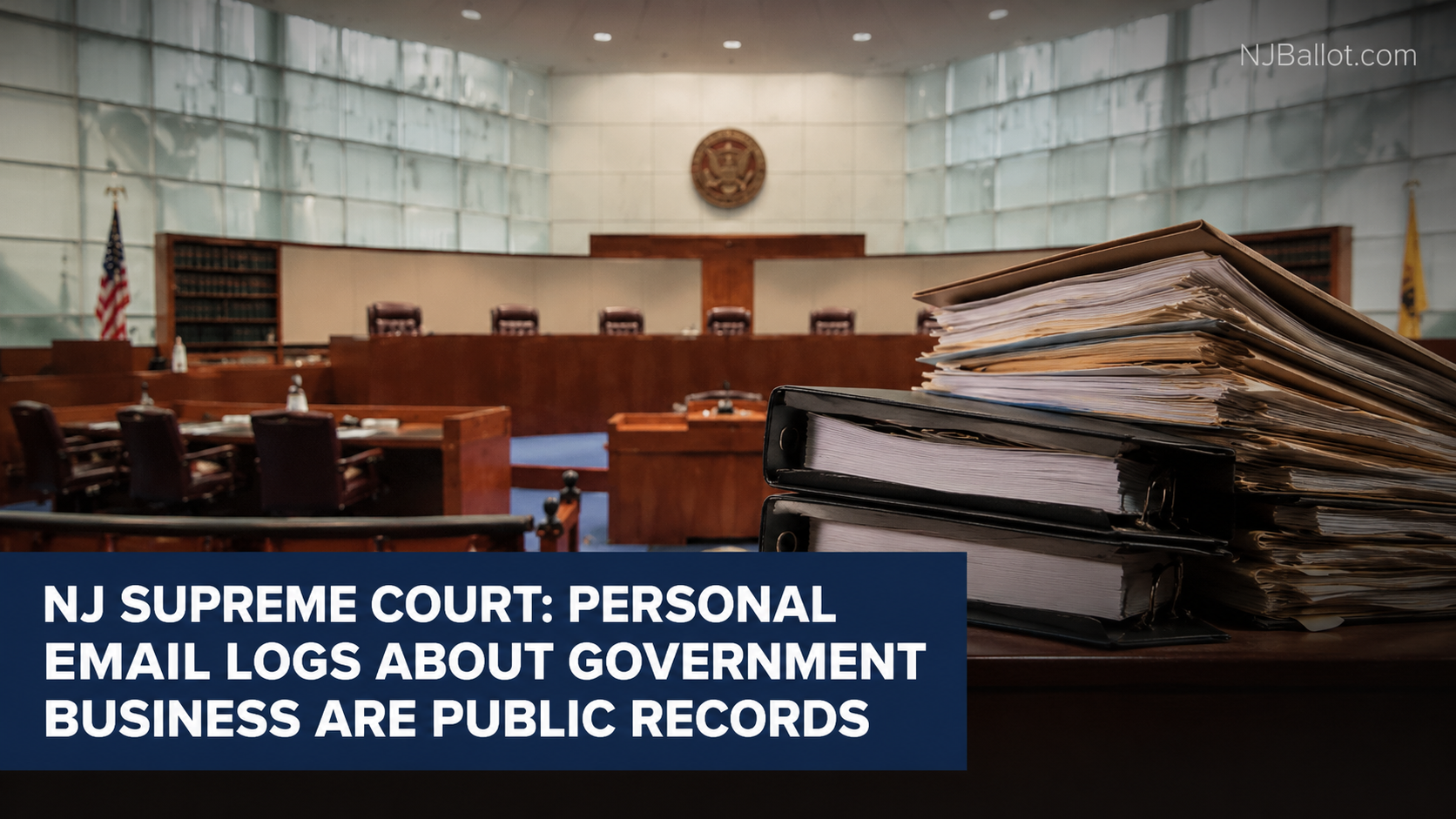

The court ruled private email logs are public records, then created a self-audit workaround.
Records custodians across New Jersey woke up Friday to a new legal reality. The New Jersey Supreme Court ruled unanimously Thursday that email logs from public officials' personal accounts are government records when they contain government-related business. The ruling binds all public bodies and will eventually force every municipality, school board and county office to figure out how to find them.
The ruling in Alex Rosetti v. Ramapo-Indian Hills Regional High School Board of Education closes a loophole that officials have used for years to conduct board business outside official channels. But it also exposes a practical gap. The board's director of technology testified that "his ability to generate logs on private servers is difficult if not impossible for many types used by the board members," according to North Jersey / USA Today Network.
The court approved a self-audit procedure instead. Board members must search their own accounts, check relevant folders and certify their work for judicial review. The opinion notes they may use any other acceptable method, but because IT staff lack administrative access to private servers, the manual approach is the workable alternative the justices created.
Justice Fabiana Pierre-Louis wrote the opinion for a unanimous court, joined by Chief Justice Stuart Rabner and Justices Anne Patterson, Douglas Fasciale, Michael Noriega, Rachel Wainer Apter and John Jay Hoffman. The justices heard oral arguments on January 5, 2026 and issued their decision on June 11.
The case began in January 2023 when Alex Rosetti, a records requester whose identity remains unknown, filed an Open Public Records Act request with the Ramapo-Indian Hills Regional High School Board of Education in Bergen County. Rosetti sought email logs from all past and current board members for every account they used to conduct school business between November 2022 and the date of response. The request asked for email logs that would list the sender, recipient, CC, BCC, date, time and subject of each message, plus any attachment names.
To satisfy that request, the board produced a log of roughly 6,000 entries across 350 pages from its district-issued Google Workspace accounts, according to the board's attorney at oral arguments this January. Those actions were consistent with the precedent the court established in 2017's Paff v. Galloway Township, 229 N.J. 340. But the board refused to produce logs from the personal email accounts. Thomas Lambe, the district's business administrator and records custodian at the time of the request, defended the denial and offered a statement about OPRA requests in general: "The safest action is often to deny a request because that can be reversed later, but once records are released that decision cannot be undone."
The log the board did produce was redacted. Rosetti claimed the redacted entries demonstrated board members were using district addresses to communicate with personal email accounts outside the system, according to the Supreme Court opinion. The trial court sided with the board in December 2023, finding that logs from personal accounts were not government records and that generating them would be too burdensome.
The Appellate Division reversed that ruling on January 27, 2025, holding that email logs on private servers are government records because the emails within them discuss board business. In February 2025, Superintendent Shauna DeMarco called the Appellate Division's earlier ruling a "significant intrusion into their privacy rights." The board appealed to the Supreme Court.
The state took the board's side in March 2025, when then-Attorney General Matthew Platkin's office filed an amicus brief asserting that email logs from private servers are not government records under OPRA and that Rosetti's request was impermissibly overbroad. Platkin's successor, Jennifer Davenport, has not commented on the June 2026 ruling as of June 12.
Court: Private Email Logs of Government-Related Business Are Public
The Supreme Court affirmed the Appellate Division's judgment as modified, a narrowing that changes the practical scope of the ruling. The justices held that only logs of government-related emails are public records, not logs of entire personal accounts. The opinion uses a stark example: "if out of 1,000 emails in a personal email account only 10 are government-related, a log of those 1,000 emails (even with the private emails redacted) cannot be said to constitute a government record under OPRA."
The justices also found Rosetti's original request overbroad. It seemingly sought logs of entire private accounts irrespective of how many non-government messages they contained. The Appellate Division's broad language that "email logs of the Board members' private servers sought by Rosetti are subject to OPRA because the emails discuss Board business" conflated the government-related emails with the entirety of the private accounts. The Supreme Court rejected that broad framing.
In 2023, Rosetti had proposed searching the district's official accounts for mentions of personal addresses, but the IT director testified that generating logs from private servers was "difficult if not impossible" because he lacked administrative access to personal accounts. The Supreme Court’s decision creates the self-audit procedure as the workable alternative: board members must search their own inboxes, sent items and deleted messages, and certify their work for judicial review.
The court also warned against conducting government business on personal email in the first place.
"Government agencies should strongly advise their employees, elected officials, and others engaged in government-related business to refrain from using their personal email accounts when conducting government-related business," the court wrote. "The issues in this case could have been avoided altogether if Board members did not use their private email accounts to conduct Board business and instead used only their government-issued email accounts, as intended."
Justices Avoided 2024 OPRA Amendment Question
The court's opinion does not mention the 2024 overhaul of OPRA. During oral arguments, Assistant Attorney General Benjamin M. Shultz raised the amendments as a secondary argument, asserting they create a "fundamentally different analysis" and exempt email metadata from disclosure. But CJ Griffin, who argued as amicus for the ACLU-NJ and Libertarians for Transparent Government, asked the court to ignore the amendments entirely. "I would request that the court not address that in its opinion," Griffin said. "It would almost be an invitation for agencies to start denying access on that basis." Her comments referred to the 2024 amendments' metadata exemption, which Griffin called the Attorney General's "pet project" to limit email transparency.
P.L. 2024, c.16 (S2930/A4045), signed June 5, 2024 and effective September 3, 2024, removed the guarantee that winning requesters get their legal fees paid. The amendments replaced automatic legal fee reimbursement with optional awards available under judges' discretion. Fees are guaranteed only when an agency unreasonably denied access, acted in "bad faith," or "knowingly and willfully" violated OPRA. The amendments also added specificity requirements for email requests, expanded redactions for personal identifying information and narrowed metadata disclosure to portions identifying authorship, editor identity and time of change.
The practical effect is a ruling that establishes the principle but leaves enforcement for the lower court to oversee. The 2024 amendments mean requesters who prevail may still bear their own legal costs unless they prove bad faith, removing the financial incentive that once pushed governments to settle rather than fight. Donald Doherty, an attorney who represented Rosetti, put it bluntly in a statement Thursday: "Five years ago, a local government would not have pushed this case to the Supreme Court."
Bergen County School Board Fight Triggered the Request
The case emerged from a bitter fight in Bergen County, where the Ramapo-Indian Hills board has been deeply divided since 2022. At the January 2023 reorganization meeting, a five-member majority of newly elected trustees and incumbents passed at least 12 last-minute motions with no significant discussion, including overturning two of the superintendent's harassment, intimidation, and bullying policies. Rosetti concluded that board members were coordinating outside official channels and filed the OPRA request. That majority no longer exists: Helen Koulikourdis became board president in January 2026, with Tom Bogdansky as vice president.
The board's insurance attorney, Jonathan Cohen of Plosia Cohen, speculated about Rosetti's motives. Cohen told North Jersey that Rosetti "might be a stand-in requester for interested parties who would rather not disclose their identities." Rosetti's attorney, Donald Doherty, did not identify his client further.
The same name appears in at least one other OPRA case. In January 2023, a person named Alex Rosetti filed a request with Parsippany Township in Morris County seeking emails, texts and Facebook posts from Councilman Justin Musella on "any email account used to conduct or participate or discuss township business whether the email account is government-owned or supplied or a privately-controlled account," according to the Daily Record. When the township failed to respond, Rosetti filed suit in Morris County Superior Court on March 1, 2023. Doherty also represented Rosetti in that case. The Daily Record attempted to reach Rosetti at the time and was unsuccessful.
The case now returns to Bergen County Superior Court, where the Ramapo-Indian Hills school board members must search their accounts, produce logs and certify their work. A trial judge will then decide if the searches were adequate or if a fact-finding hearing is needed. Nearly three and a half years after Rosetti filed his request, the board has still not produced a single log. The Supreme Court established the principle; the lower court must enforce it. And records custodians across New Jersey are watching to see if the principle has any weight.
Related Articles
U.S. Supreme Court Upholds NJ Affordable Housing Mandate, Denies Towns' Emergency Bid
Jersey City School Board Approves 17% Tax Levy Amid $74M Aid Loss
Sources
• Alex Rosetti v. Ramapo-Indian Hills Regional High School Board of Education and Thomas Lambe, in his official capacity as Records Custodian, Supreme Court of New Jersey, Docket No. A-72-24 (090375) (June 11, 2026)
• Alex Rosetti v. Ramapo-Indian Hills Regional High School Board of Education and Thomas Lambe, in his official capacity as Records Custodian, N.J. Super. Ct. App. Div., Docket No. A-1466-23 (January 27, 2025)
• Oral Arguments for Rosetti v. Ramapo-Indian Hills Regional High School Board of Education, Supreme Court of New Jersey, Docket No. A-72-24 (January 5, 2026)
• New Jersey Legislature, P.L. 2024, c.16 (S2930/A4045) (June 5, 2024)
• Office of the Attorney General, Amicus Curiae Brief, Rosetti v. Ramapo-Indian Hills Regional High School Board of Education, Docket No. A-72-24 (March 14, 2025)
• John Paff v. Galloway Township, 229 N.J. 340 (2017)
• Ramapo-Indian Hills Regional High School District, Comprehensive Annual Financial Report, Fiscal Year 2024 (June 30, 2024)
• Ramapo-Indian Hills Regional High School District, Regular Public Meeting Agenda (June 16, 2025)
• Ramapo-Indian Hills Regional High School District, Regular Public Meeting Agenda (March 2, 2026)
• Bloomberg Law, "NJ Justices Expand Disclosure of Public Officials' Private Email" (June 11, 2026)
• Daily Record, "Lawsuit says Parsippany ignored request for emails and texts of councilman under fire" (March 11, 2023)
• Jersey Vindicator, "New Jersey Supreme Court: Government-related emails in officials' personal accounts are subject to OPRA" (June 11, 2026)
• New Jersey Monitor, "NJ high court urges officials not to use personal email for government business" (June 11, 2026)
• NJ Spotlight News, "NJ Supreme Court rules on OPRA, personal email" (June 11, 2026)
• North Jersey / USA Today Network, "Appellate judge orders Ramapo Indian Hills school board to turn over personal email log" (Feb. 3, 2025)
• North Jersey / USA Today Network, "Ramapo Indian Hills NJ school board picks new leadership" (Jan. 7, 2026)
• The Ridgewood Blog, "Appellate Court Orders Ramapo Indian Hills School District to Release Trustees' Personal Email Logs" (Feb. 7, 2025)
• Yahoo News, "NJ high court urges officials not to use personal email for government business" (June 11, 2026)