
The state touts $122.8 million in recoveries. A single pending lawsuit demands $123.9 million from two facilities. AARP found $2 billion in related-party payments. The numbers don't add up the way the headline suggests.
TRENTON, N.J. — The New Jersey Monitor ran a headline last week declaring New Jersey "on track to recover nearly $200 million in fraudulent Medicaid payments." The Office of the State Comptroller's own account posted a more conservative figure the same day: $122.8 million through April. Acting State Comptroller Shirley Emehelu and Attorney General Jennifer Davenport held a joint media push on Tuesday to rebut White House criticism that Democratic-run states are lax on program oversight. The Trump administration, through Vice President J.D. Vance, has convened closed meetings of state fraud investigators that, according to News From The States, excluded Democratic offices.
The headline looks like a triumph. The arithmetic underneath it tells a different story.
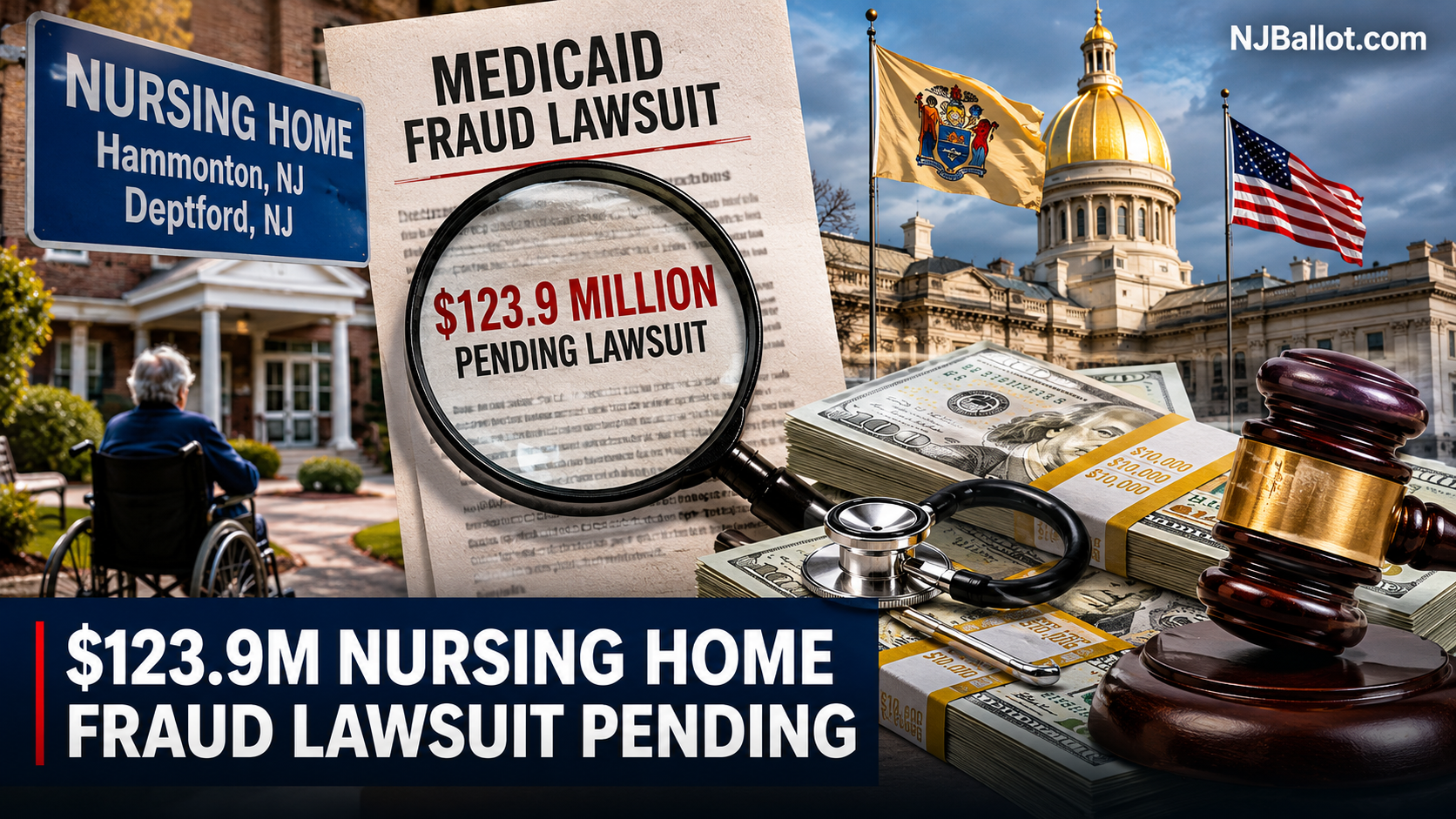
The $122.8 million recovered through April 2026 sits alongside a single active lawsuit demanding $123.9 million from just two South Jersey nursing homes: Hammonton Center for Rehabilitation and Healthcare in Atlantic County, and Deptford Center for Rehabilitation and Healthcare in Gloucester County. That lawsuit, filed in Superior Court on January 19, 2026, names 33 defendants including the owners Daryl Hagler and Kenneth Rozenberg, their family members, and a web of related entities.
The Comptroller's office is seeking $86.3 million for staffing deficiencies extrapolated across the review period, $35.5 million for real estate scams, $2.1 million for unsupported related-party payments, plus $980,000 in civil penalties for registered nurse violations. Not one dollar of that $123.9 million has been recovered as of writing. The demand is pending, the defendants have not admitted liability, and no trial date has been publicly announced.
The New York Attorney General secured a $45 million settlement from the same network in November 2024, including $8.75 million in restitution to Medicaid and Medicare and $35 million to a Resident Care Fund. That suggests the defendants have paid substantial sums before and are not judgment-proof. But the $122.8 million headline the office is using comes from enforcement actions elsewhere in the Medicaid program, while the largest single enforcement action the office has ever mounted remains pending in Superior Court.
Kevin Walsh served six years as acting comptroller before departing on January 18, 2026, near the end of former Governor Phil Murphy's administration. He gave an exit interview on January 20, saying lawmakers had done "pretty much nothing" on nursing home reform despite repeated reports. By March 6 he had joined Philadelphia law firm Langer Grogan & Diver P.C. as a partner. The firm's health care client list has not been reviewed for potential conflicts. Emehelu, a former federal prosecutor, stepped in as acting comptroller in late January. In this capacity she delivered budget testimony on May 20.
The question is whether the enforcement architecture is adequate to the scale of the problem it confronts.
The Comptroller's own investigators found that Hagler and Rozenberg diverted $92 million in related-party payments from Hammonton and Deptford into companies controlled by themselves, their children, and their in-laws. Of that $92 million, only $882,666—less than one percent—was disclosed on mandatory state and federal cost reports. The remaining $91.1 million was hidden through false filings. The concealment ratio shows not sloppy bookkeeping, but systematic omission.
That $92 million in concealed payments surrounding two facilities sits against a broader landscape that AARP New Jersey documented in a June 2025 white paper. The group found that 82 percent of New Jersey nursing homes reported related-party payments in 2023, averaging over $2 million per facility, with nearly $2 billion in such payments flowing between 2021 and 2023. Related-party payments are legal and common in health care; AARP's report flags potential excess, not proven fraud. But of that volume, AARP identified $285 million in payments that appeared to exceed allowable federal cost standards. The Comptroller's $122.8 million annual recovery represents just under half of the related-party payment volume AARP flagged as potentially excessive in that two-year window.
The state is not just recovering money. It is recovering money while the Legislature dismantles the tools that would prevent the next wave of fraud. The Department of Human Services had regulations permitting state officials to stop payments to one-star facilities. The Legislature overrode those rules in the FY2026 budget.
Some lawmakers have proposed nursing home reform bills. Senate Bill S-2980, sponsored by Democratic Senators Joseph Vitale (19th) and Angela McKnight (31st), would require audited consolidated financial reporting for nursing homes and tighten related-party transparency. The bill has not advanced. In January 2026 Walsh said legislators had "ignored every single recommendation" he made and enacted only "performative reform.”
The executive branch advertises $122.8 million in recoveries, while the Senate bill that would have exposed the Hammonton and Deptford self-dealing stalls in the legislature. Meanwhile the legislature eliminated one of the quality enforcement tools that would have shut down the facilities. The new legislation aims to fill that reporting gap and prevent a repeat situation, but it must first clear the Legislature and become law.
The federal context adds another layer of contradiction. State Department of Human Services Commissioner Sarah Adelman acknowledged in budget testimony on May 6 that even $122.8 million in annual fraud recovery cannot offset the $6 billion in annual federal funding cuts that would result from current Republican congressional proposals. The cuts are proposed, not enacted, but they shape the political context in which the $122.8M figure is being deployed.
The Trump administration signed a March executive order creating a federal fraud task force and has accused Democratic-led states of lax oversight. The White House is simultaneously demanding fraud crackdowns and threatening to slash the program by roughly 50 times the annual recovery total.
The state Comptroller's office has recovered more than $1.2 billion since 2014, with annual totals climbing from $114.5 million in fiscal year 2023 to $119.2 million in fiscal year 2024 to $132.5 million in fiscal year 2025. The trend line is upward. But the Hagler and Rozenberg network operates 46 nursing homes across four states: 31 in New York, plus New Jersey, Kansas, and Missouri. No enforcement action in Kansas or Missouri has been publicly documented.
The 122.8 million figure is real. The office has the documentation. But it is a peashooter against a cannon—a cannon the federal government is threatening to fire, a cannon the state Legislature has left unloaded, and a cannon that the nursing home industry appears to have aimed at the Medicaid program for years without detection.
Sources
· NJ Office of the State Comptroller, X post, "OSC's Medicaid Fraud Division has recovered more than 122.8M so far in FY 2026" (May 27, 2026)
· NJ Office of the State Comptroller, "Office of the State Comptroller Sues Hammonton and Deptford Nursing Home Owners and Associates for Medicaid Fraud; Bridgeton Nursing Home Suspension Set for March 13, 2026" (January 19, 2026)
· NJ Office of the State Comptroller, "Investigation Uncovers Massive Medicaid Scam at Two NJ Nursing Homes" (December 10, 2025)
· New Jersey Monitor, "NJ on track to recover nearly 200 million in fraudulent Medicaid payments" (May 27, 2026)
· Law360 Pulse, "New Acting NJ Comptroller Takes Reins At Battle-Tested Office" (February 9, 2026)
· Office of the State Comptroller, NJ.gov, "Shirley U. Emehelu Biography" (n.d.)
· New Jersey Monitor, "Exiting NJ comptroller blasts lawmakers' 'acquiescence' of corruption" (January 20, 2026)
· Langer Grogan & Diver P.C., "Former New Jersey Acting State Comptroller Kevin Walsh Joining Langer Grogan & Diver P.C." (March 6, 2026)
· AARP New Jersey, "The Tangled Financial Web of New Jersey Nursing Homes" (June 6, 2025)
· Sarah Adelman, NJ Department of Human Services, "FY2026 Budget Testimony" (May 6, 2025)
· NJ Office of the State Comptroller, "New Ownership Group for South Jersey Nursing Home Blocked from Medicaid Due to Risks of Fraud, Waste, and Abuse" (November 20, 2025)
· New York Attorney General, "Attorney General James Secures 45 Million and Delivers Major Reforms to Four Nursing Homes Following Significant Financial Fraud and Resident Neglect" (November 14, 2024)
· NJ Office of the State Comptroller, "Medicaid Fraud Division Annual Report FY2025" (2025)
· News From The States, "NJ defends record on uncovering Medicaid fraud in response to White House criticism" (May 28, 2026)
· Jersey Vindicator, "N.J. Legislature's Budget Overturns Nursing Home Safety Regulations" (July 1, 2025)
· North Jersey, "Budget does away with program to stop payments to low-rated nursing homes" (July 3, 2025)
· AARP New Jersey, "New Jersey Must Pass Nursing Home Financial Transparency Bill" (n.d.)