
TRENTON — The New Jersey Department of Labor adopted regulations on May 5 that will place Uber drivers, Lyft operators and trucking owner-operators in the employee presumption under the state's worker classification test. The rule takes effect October 1.
The Legislature had a constitutional way to stop it. It never reached a vote.
Acting Labor Commissioner Kevin Jarvis announced the adoption of N.J.A.C. 12:11, a new chapter of administrative regulations that codifies how the department applies New Jersey's "ABC test" for worker classification. The test has been state law since 1936. Under it, a worker is presumed to be an employee unless a company can prove three things: the worker is free from company control, performs work outside the company's usual course of business, and engages in an independent trade or business.
The department's guidance indicates ride-hail drivers and trucking owner-operators will fail Prong B of the test. The department explicitly stated that a driver transporting riders for a transportation network company is not outside that company's usual course of business. Trucks, airplanes and vehicles used for transportation services remain company places of business under the rule.
Jarvis framed the action as clarification, not expansion. "At its core, this action has always been about protecting workers through fairness and clarity," he said. "When expectations are set, responsible employers can compete on a level playing field, without being undercut by those who misclassify workers."
The department received more than 9,500 public comments during a 90-day comment period, according to its press release. The department noted it extended the comment period and held a public hearing in response to the volume of feedback.
The final rule includes several concessions business groups demanded. The Sherrill administration removed a proposed sub-factor that would have counted digital apps and software as evidence of company control. It eliminated illustrative examples from the text of Prong B. It reversed a provision on compliance-driven controls, so actions taken solely to obey the law will not count against employers. It added language clarifying that a worker's personal residence used for remote work is not a company "place of business."
Business groups said the concessions were insufficient. Michele Siekerka, president of the New Jersey Business and Industry Association, said the rule "has not gone far enough at all in providing needed flexibility and clarity for freelancers and businesses." She noted the association had received more than 9,500 letters opposing the rule. "Our work here is far from done," Siekerka said. "We will continue to work alongside the Legislature and administration toward a further revised rule that recognizes the need to preserve the exact jobs and opportunities that remain in jeopardy."
Labor groups were more supportive. Charles Wowkanech, president of the state AFL-CIO, said the rule was not intended to hurt legitimate independent contractors. "However, when intentionally misclassified, businesses drastically increase profits on the backs of working people, and that must end," he said. NJBallot found no statements from other labor organizations beyond the AFL-CIO in the public record.
The constitutional friction predates the adoption by months. On November 14, 2025, Senator Declan O'Scanlon and Assemblywoman Vicky Flynn, both Republicans, introduced Senate Concurrent Resolution 138 and Assembly Concurrent Resolution 177. The resolutions asserted that the proposed rule conflicted with legislative intent and invoked the Legislative Review Clause of the New Jersey Constitution. That clause, added by constitutional amendment in 1992, gives the Legislature power to review agency rules and invalidate those inconsistent with statute.
The process has two phases. First, a concurrent resolution asserting inconsistency triggers a 30-day window for the agency to amend or withdraw the rule. The Department of Labor did neither. The second phase requires a second concurrent resolution, a public hearing and majority votes in both houses to invalidate the rule.
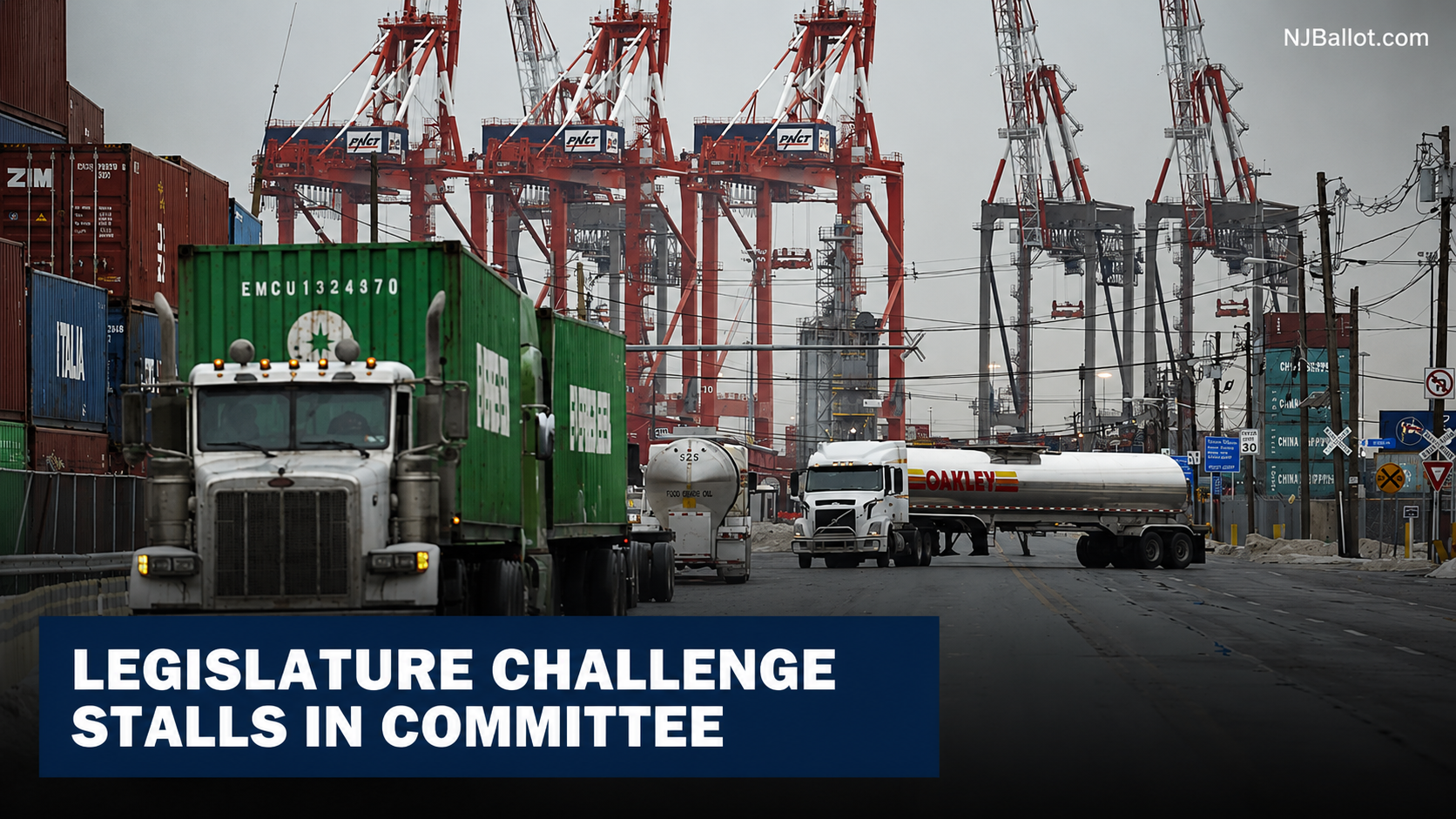
The resolutions never reached the second phase. ACR177 died in the Assembly Labor Committee on January 12, 2026. SJR-138 stalled in the Senate Labor Committee and was carried over to the 2026 session. NJBallot could not determine whether Democratic committee leadership actively blocked the resolutions or whether they stalled for procedural reasons. The resolutions were Republican-sponsored; Democrats control both chambers and all committee chairs.
Several Democrats previously opposed the proposal, including legislators from Monmouth and Middlesex counties. Neither they nor Republican sponsors issued post-adoption statements.
While the constitutional challenge stalled, Senator Gordon Johnson, a Democrat from Bergen County, pursued a different path. He introduced S-4839, which would exempt licensed and regulated professionals in finance, insurance and trucking from the rule's strictures. That bill remains in the Senate Labor Committee. NJBallot attempted to reach Johnson's office for comment on the bill's status; no response was received by publication.
Management-side attorneys who commented during the rulemaking process argued the department had exceeded its statutory authority. Thomas Linthorst of Morgan Lewis and Bockius described the proposal in August 2025 as "something of an end-run on the legislature." Marissa Mastroianni of Cole Schotz said the rule went beyond existing case law, particularly on Prong B, and would make it impossible for some companies to use independent contractors at all. The New Jersey State Bar Association also filed comments arguing that binding examples in the proposed rule effectively predetermined outcomes in specific scenarios — a legislative function, not a regulatory one.
The department directly addressed that objection in its adoption notice. It eliminated the examples from the rule text but kept the underlying standards. It cited the New Jersey Supreme Court's 2022 decision in East Bay Drywall, in which the court invited the department to "exercise its statutory authority and expertise" to clarify the ABC test. The department's position: it was not adopting new law but responding to judicial invitations.
The rule also creates a federal-state compliance gap. While New Jersey tightens its ABC test, the federal Department of Labor is moving toward a five-factor "economic reality" test that would make contractor classification easier. The federal proposed rule's comment period closed April 28. No federal preemption applies — New Jersey's standard will govern within its borders.
Despite the scale of the rule, NJBallot found no direct testimony from gig worker organizations in the public record or post-adoption statements. Lyft spokespersons did not return an email seeking comment. No company has announced intent to challenge the rule in court, though prior litigation suggests the possibility — Uber paid New Jersey $100 million in 2022 to resolve misclassification claims; and Lyft paid $19.4 million in 2024.
NJBallot found no evidence of OPRA requests or documentary litigation in the public record connected to the rulemaking process. The reason for the absence of OPRA activity is unclear.
The 120-day window closes September 1. If Johnson's exemption bill does not advance, the rule takes effect unchanged. The Legislature attempted a constitutional challenge. It ended in committee, with no recorded vote.
Sources
New Jersey Department of Labor and Workforce Development, "NJDOLWD Adopts Clear Rules to Prevent Worker Misclassification," press release, May 5, 2026.
New Jersey Monitor, "NJ Adopts Independent Contractor Rules Criticized by Freelancers, Gig Workers," May 5, 2026.
Jersey Vindicator, "Gig Economy Shakeup: New Jersey Adopts Worker Classification Rules That Will Likely Make Ride-Hailing Drivers Employees," May 5, 2026.
NJ 101.5, "1.7 Million NJ Gig Workers Impacted by Controversial New Rule Change," May 5, 2026.
New Jersey Business and Industry Association, "NJBIA Statement on Adoption of NJDOL Rule Changing ABC Test for Independent Contractors," statement, May 5, 2026.
New Jersey Register, "Notice of Adoption: N.J.A.C. 12:11 Worker Classification," adoption notice, May 5, 2026.
Epstein Becker Green, "NJ Legislature Considers Resolution to Block Proposed Worker Classification Rule," Dec. 22, 2025.
Legiscan, "ACR177 — Disapproves Proposed Readoption with Amendments of Worker Classification Rule," status, accessed May 5, 2026.
BillTrack50, "ACR177 — New Jersey 2025–2026 Regular Session," accessed May 5, 2026.
N.J. Constitution, Art. V, Sec. 4, Par. 6 (Legislative Review Clause).
New Jersey Supreme Court, Communications Workers of America v. Civil Service Commission, 2018.
Cole Schotz, "NJ Department of Labor Proposed Independent Contractor Rule: What Employers Need to Know," Aug. 18, 2025.
Nelson Mullins, "DOL Issues Proposed Rule on Independent Contractor Classification," Mar. 4, 2026.
Hunton Andrews Kurth, "DOL Proposes Five-Factor Test for Independent Contractor Classification Under FLSA," Mar. 4, 2026.
Genova Burns, "NJ DOL Proposes New Regulations Regarding Classification of Independent Contractors," May 22, 2025.
New Jersey State Bar Association, "NJSBA to Submit Concerns on Proposed DOLWD Rule," Capitol Report, Jul. 2025.
NJ Legislature, "S-4839 — Exempts Certain Licensed Professionals from Worker Classification Rule," introduced Nov. 14, 2025.
NJ Legislature, "SJR-138 — Disapproves Proposed Readoption with Amendments of Worker Classification Rule," introduced Nov. 14, 2025.