
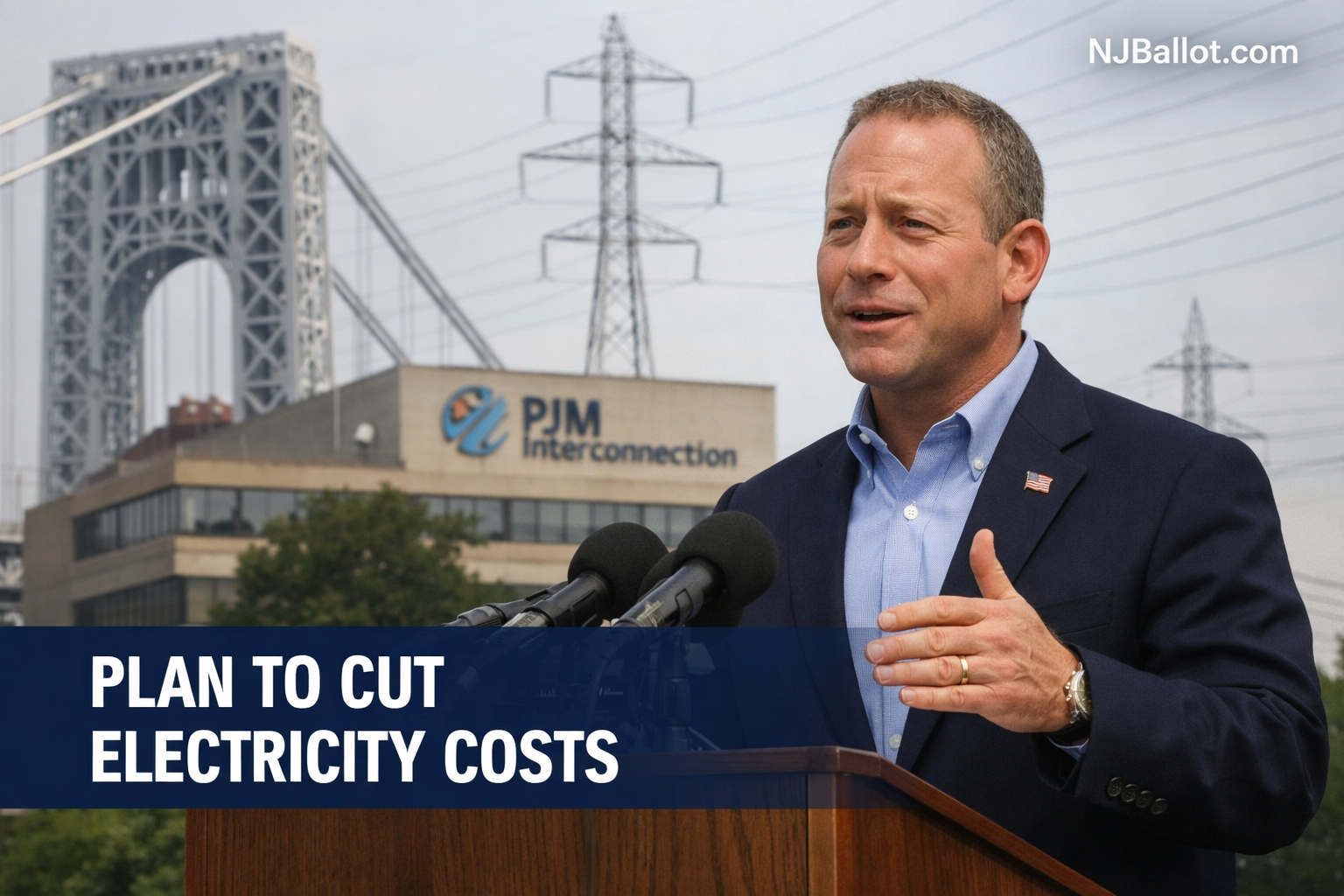

TRENTON—New Jersey electricity bills have surged 45 percent over the past two years, prompting a federal lawmaker to propose an "all-of-the-above" energy strategy to lower costs. Rep. Josh Gottheimer announced the plan on March 16 in Fort Lee, alongside labor leaders and local officials.
Gottheimer said the increase has placed additional financial strain on families already facing high costs of living. "Energy isn't a luxury — it's a necessity," the North Jersey Democrat said. "Nobody in this state should be sweating over an electric bill at the kitchen table."
New Jersey's electricity rates jumped approximately 20 percent on June 1, 2025, with average monthly bills rising more than $20. The state already had among the highest rates in the country, with prices climbing 55 percent from 2020 to 2025, the sixth-highest jump nationally. Current residential rates stand at 22.98 cents per kilowatt-hour as of December 2025, up from 19.41 cents in December 2024 and an 18.4 percent annual surge.
This spike stems from a supply-demand imbalance in the regional power market. Energy demand has grown nearly 10 percent over the last five years and is projected to rise 25 percent by 2030, driven by data centers and artificial intelligence. At the same time, New Jersey has lost roughly 1,500 megawatts of generating capacity over the past eight years, enough to power about 1.2 million homes.
PJM Interconnection, the regional grid operator serving 67 million customers across 13 states including New Jersey, conducts annual capacity auctions that directly impact utility prices. The July 2024 auction set prices at $269.92 per megawatt-day, up nearly ten times from $28.92 in December 2022. The July 2025 auction raised prices further to $329.17 per megawatt-day. The December 2025 auction hit $333.44/MW-day, a record high for the third consecutive auction.
Gottheimer's plan includes six key steps: expand power generation through natural gas, nuclear, solar, hydroelectric, geothermal and battery storage; accelerate permitting reform; fix PJM's regional power system; improve coordination between federal, state and local agencies; convert aging coal plants to cleaner energy; and provide immediate relief for families facing high bills.
He is sponsoring several bipartisan bills with Rep. Mike Lawler (R-NY) to modernize energy infrastructure: the Making Reviews Certain Act, the Grid Expansion and Reliability Act, the Commonsense Review Act, and the Build More Power Act.
Gov. Mikie Sherrill issued Executive Order No. 1 on January 20, declaring a state of emergency on utility costs and compelling the Board of Public Utilities to issue Residential Universal Bill Credits by July 1, 2026. The BPU had already released results in February 2025, showing higher prices due to PJM capacity market connections.
New Jersey has 5.4 percent unemployment, the second-highest rate in the nation behind California. The state lost 3,960 jobs in early 2026 as 34 companies announced layoffs. Rising energy prices add further costs to consumers and increase the overall cost of living.
Sources
- Gottheimer Official Release (March 16, 2026)
- NorthJersey.com (March 17, 2026)
- U.S. Energy Information Administration (December 2025)
- NJ Spotlight News (June 2025)
- NJ Board of Public Utilities (February 2025, January 2026)
- PJM Interconnection Official Data (2022-2025)
- NJ 101.5 (March 2025)
- NJ Department of Labor and Workforce Development (March 2026)