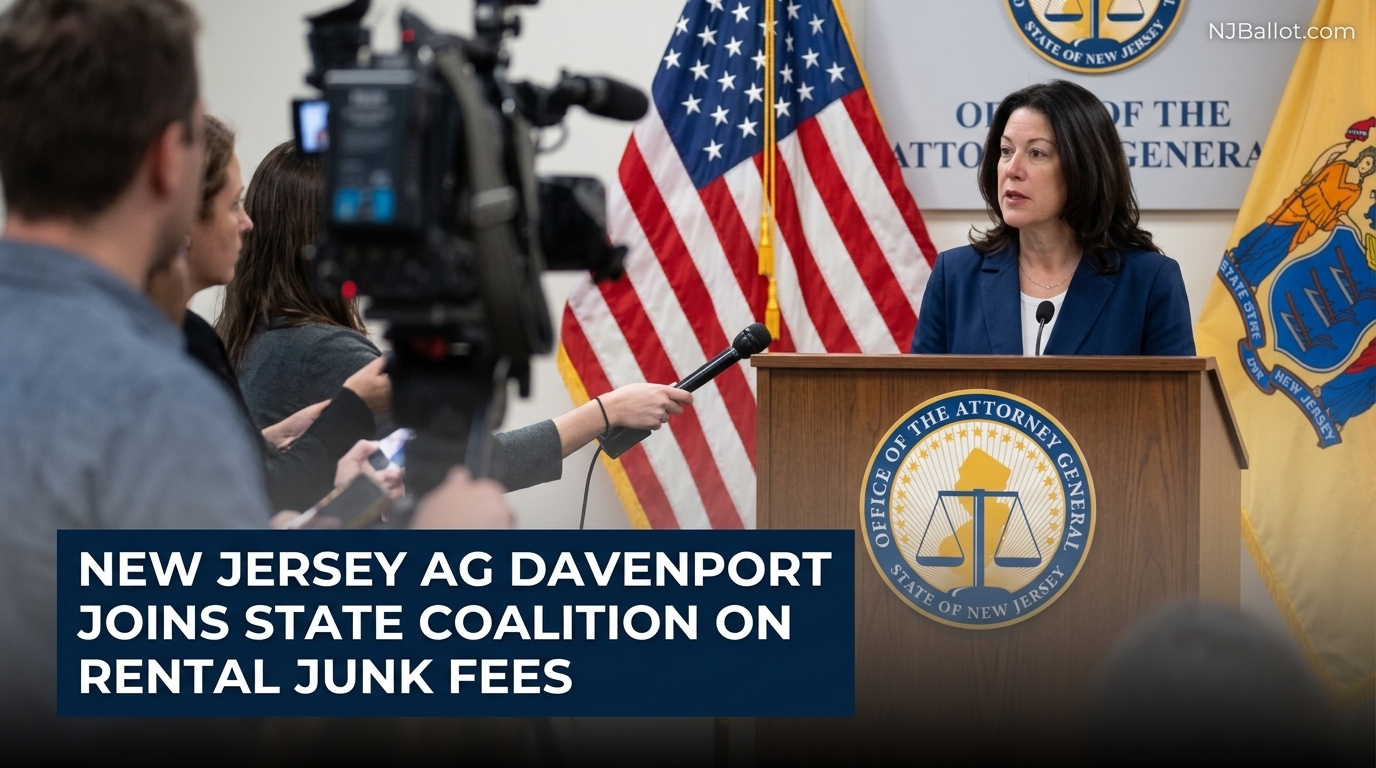

TRENTON—New Jersey Attorney General Jennifer Davenport announced on April 13 the state’s participation in a coalition of 26 states and Washington, D.C., demanding federal action on rental housing junk fees. The coalition letter to the Federal Trade Commission continues Davenport's previous multistate efforts on civil rights and administrative policy since her February confirmation.
But the coalition faces structural challenges. Of the 27 signatories, only two are Republicans. It also excludes Texas and Florida, states with substantial rental markets that have historically resisted federal regulatory coordination on housing policy.
Coalition Construction with Two Major Absences
The 27-jurisdiction coalition is, by the numbers, a Democratic operation. Approximately 93% of signatories are Democratic-affiliated attorneys general. Republican participation is limited to Alaska's Stephen J. Cox and Pennsylvania's Dave Sunday. This composition matters because Davenport's office emphasized the coalition's bipartisan character. The claim is technically accurate, but it is misleading. Furthermore, the Republican AGs from Texas and Florida did not sign. These absences exclude states with significant rental markets: Texas has approximately 2.5 million apartment units, and Florida has roughly 2.8 million renter-occupied households. Together these states represent a substantial portion of the national rental housing stock.
Florida also has a history of preempting local housing regulations and resisting federal coordination. The state has banned rent controls since 1977, and its current Governor has pursued action against municipalities that attempt to impose such reforms. The context and the states' lack of participation in Davenport's suit suggests distinct regulatory philosophies regarding federal intervention in rental housing markets and ideological divergence from the coalition's approach to consumer protection mandates. Regardless of the causes, their absence still leaves Davenport's coalition down two major potential allies.
A Federalist Approach
The coalition's letter to the FTC requests a federal rule that sets minimum standards for rental fee disclosure while explicitly preserving state authority to enact stronger protections. This approach reflects lessons from previous multistate coordination efforts. The coalition's approach reflects broader patterns in federal-state coordination on consumer protection. State attorneys general have historically used multistate letters to influence federal rulemaking, particularly when corporate entities operate across jurisdictions and create enforcement challenges for individual states.
But federal volatility may create its own problems. Last year the Trump administration significantly reduced activities by the Consumer Financial Protection Bureau, and still wants to slash its staffing from almost 1,700 positions to just 200. A report by Senator Elizabeth Warren (D-MA) showed that the reduction had cost Americans over $19 billion in just the past year alone. The possible closure of the CFPB may force state AGs to accept that federal administrative protection is not necessarily permanent.
Davenport's strategy also addresses a structural problem. Corporate landlords like Invitation Homes, which settled FTC charges of junk fees and deceptive pricing for $48 million in September 2024, operate across dozens of states. A federal disclosure requirement would apply uniformly, while the preservation clause would allow high-regulation states to maintain their existing caps.
New Jersey's State Law
Before Davenport even pursued federal action, New Jersey's legislature enacted its own solution. A. 4899, signed by Governor Phil Murphy on January 20, 2026, and effective May 1, 2026, caps rental application fees at $50. The timing gives Davenport an example that federal standards need not preempt stronger state protections.
The New Jersey law includes annual CPI adjustments and enforcement through the state's Consumer Fraud Act. It also includes exemptions for one-to-two family dwellings and licensed real estate brokers. Davenport's office issued guidance warning of fines ranging from $500 to $1,000 for violations.
The Upshot
Davenport's coalition represents a response to a genuine coordination problem. Rental housing fees create information gaps between landlords and tenants, with tenants often discovering mandatory charges only after beginning the application process.
But the coalition's limitations are significant. The thin Republican participation creates vulnerability to partisan attack. The absence of Texas and Florida undermines claims of addressing the national rental market. And the dependence on FTC action introduces a federal reliance that Davenport and her allies cannot control.
For now, the coalition holds. Whether it becomes a template for AG coordination or a footnote in federalism experiments depends on the FTC's next move.
Sources
• New Jersey Office of the Attorney General, "Attorney General Jennifer Davenport Leads Coalition of 27 State Attorneys General Urging FTC to Address Deceptive and Hidden Rental Fees" (April 13, 2026)
• Davenport, Jennifer, et al, "Comment Letter to Federal Trade Commission Regarding Project No. R207011—Unfair or Deceptive Fees in the Rental Housing Industry"(April 13, 2026)
• New York State Attorney General, "Attorney General James Leads Coalition of 26 Attorneys General Urging Federal Trade Commission to Address Unfair and Deceptive Fees in Rental Housing" (April 13, 2026)
• David J. Toscano, Harvard Advanced Leadership Social Impact Review, "State Preemption and the Fracturing of America" (November 8, 2022)
• The Capitolist, "In Florida, a court case and the governor's signature put the final nail in rent control's coffin" (April 18, 2023)
• Federal Trade Commission, "FTC Takes Action Against Invitation Homes for Unfair and Deceptive Junk Fees and Deceptive Pricing" (September 19, 2024)
• Texas A&M University Real Estate Center, "2024 Annual Report on the Texas Apartment Market" (2024)
• Ken Sweet, Associated Press "Trump administration's changes to CFPB cost Americans $19B, a new report says" (February 9, 2026)
• Point2Homes, "Florida Renter vs. Owner Statistics 2024" (2024)
• New Jersey Legislature, Assembly Bill No. 4899