
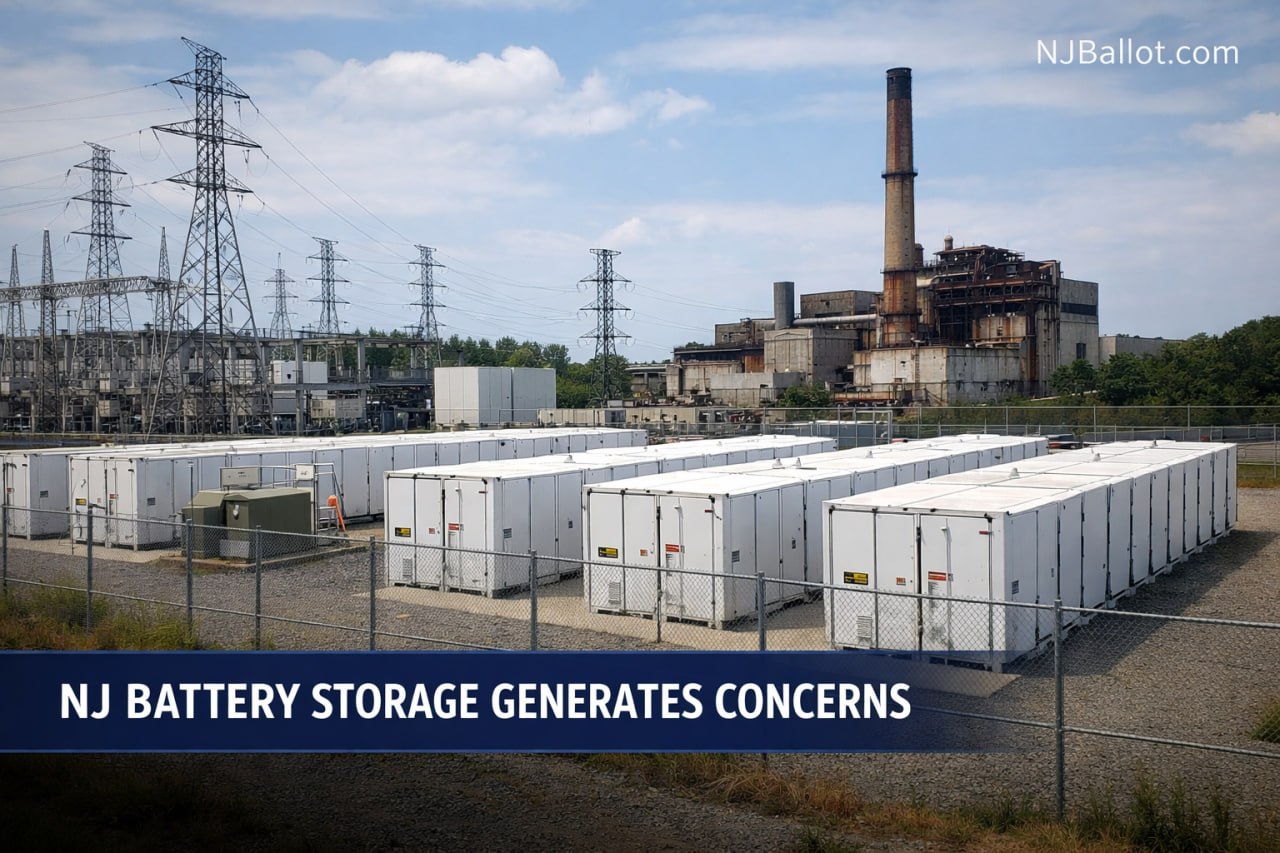

TRENTON—The New Jersey Board of Public Utilities awarded $15 million in incentives for a 200-megawatt battery storage facility in Sayreville on March 5, highlighting benefits for 450,000 community solar subscribers. Simultaneously, regional grid operators and state consumer advocates have raised questions about whether the infrastructure investments align with emerging large-load demands from industrial facilities.
Three New Power Storage Contracts
The NJBPU awarded 355 megawatts of battery storage capacity to three developers on March 5, 2026. Woods Landing Storage LLC, a Jupiter Power subsidiary, was allocated 200 megawatts for a site in Sayreville with $15 million in total incentives. That totals $75,000 per megawatt and $156 per megawatt annually. Two Rivers Energy Storage LLC secured 150 megawatts in Ridgefield, Bergen County. North America Energy Storage Corp. took 5 megawatts in Bordentown, Burlington County.
The announcement packaged these awards with a 3,000-megawatt community solar expansion with 51 percent designated for low- to moderate-income households. It has been described as the largest state allocation of solar panels in the country.
BPU officials emphasized that the awards require no new rate increases and will reduce capacity costs by $333 million. The financing draws from the Societal Benefits Charge, an existing component of residential electric bills.
What's Causing Increased Energy Needs?
However, regional grid assessments suggest multiple factors are driving the infrastructure need. In December 2025, PJM Interconnection, the regional operator serving thirteen states, reported a 6,623-megawatt shortfall below reliability requirements. PJM noted a continued trend of large data center loads being added to forecasts, with such facilities entering bilateral contracts at twice standard capacity prices.
The operator's interconnection queue contains 290 gigawatts of renewable generation, though historically less than five percent of that total has reached commercial operation.
The New Jersey Division of Rate Counsel cited these trends in a January 20 federal filing, suggesting that data center load growth is a primary driver of grid demand increases. Director Brian O'Hara urged federal regulators to maintain price caps until transparent cost allocation for large industrial loads is implemented. The filing noted that data centers are securing contracts at premium rates while bringing their own power generation infrastructure, potentially creating a dual-track system.
Infrastructure Changes throughout New Jersey
The Sayreville site illustrates the infrastructure transition. On March 20, the Middlesex County borough's redevelopment authority designated Woods Landing Energy Storage LLC as the developer for a former coal-fired power plant undergoing environmental remediation. Jersey Central Power & Light, a FirstEnergy subsidiary, executed the interconnection agreement. The site sits on existing transmission infrastructure originally built for coal generation, but it's now being repurposed for battery storage.
Multiple interpretations of the deployment are supported by the documentation. State officials could view the battery storage upgrades as necessary grid modernizations to retain industrial employers. The Sayreville location supports job retention in the central corridor, though specific facility beneficiaries are not identified in public filings.
Alternatively, consumer advocates might question whether residential ratepayers are financing infrastructure that primarily benefits large industrial users. The Rate Counsel filing suggests concern that cost allocation remains unresolved, potentially leaving residential customers bearing reliability costs while industrial users secure premium bilateral contracts.
Engineer readers might note that battery storage serves technical requirements regardless of load source. PJM's reliability shortfall indicates that grid stabilization needs exist independent of specific consumer categories.
More Awards to Come
The BPU has opened a second tranche of 645 megawatts of battery storage, indicating the program extends beyond initial awards. Environmental organizations have advocated for maintaining price caps until cost allocation reforms are implemented, protecting residential ratepayers from immediate spikes while leaving transparency questions for future regulatory proceedings.
Politico NJ reported that the awards would reduce capacity costs by $333 million, emphasizing community solar benefits for 450,000 subscribers. The publication did not address the PJM data center correlation or Rate Counsel cost allocation concerns.
The specific industrial beneficiaries of the Sayreville and Ridgefield capacity remain unidentified in public filings; bilateral contracts with utilities are confidential. Whether the infrastructure primarily serves residential stability, industrial expansion, or combined load growth remains subject to interpretation of the competing grid assessments.
Sources
New Jersey Board of Public Utilities, "NJBPU Approves Over 355 MW of Battery Storage," NJ.gov (March 5, 2026)
PJM Interconnection, "2027/2028 Base Residual Auction Report," PJM.com (December 2025)
New Jersey Division of Rate Counsel, "FERC Filing EL25-49-000," Federal Energy Regulatory Commission (January 20, 2026)
Sayreville Borough, "Redevelopment Authority Resolution," Municipal Records (March 20, 2026)
JD Supra, "New Jersey BPU Battery Storage Projects," Industry Documentation (March 2026)
Politico New Jersey, "Battery Storage Cost Reduction Analysis," (March 9, 2026; March 23, 2026)