
ALLOWAY TOWNSHIP—The Facebook post was routine, almost mundane. On April 4, 2025, Gail Nazarene, newly elected to the Alloway Township Board of Education, asked her constituents a straightforward question: "As a resident of Alloway, I am wondering what other residents think about a 9-15% school tax increase?"
She added a disclaimer, just to be safe: "This is MY opinion and NOT the opinion of Alloway Twp BOE."
Three days later, another board member delivered a warning that would upend her understanding of elected office. Her post, Nazarene was told, was akin to "yelling fire in a crowded theater," a phrase lifted from a century-old Supreme Court decision justifying the punishment of anti-war protesters.
It remains unclear whether this was the same board member who would later file an ethics complaint against her. Shortly after the formal complaint, Nazarene stopped posting entirely. And on November 20, 2025, the 68-year-old Navy veteran and grandmother became the lead plaintiff in a federal First Amendment lawsuit against the State of New Jersey.
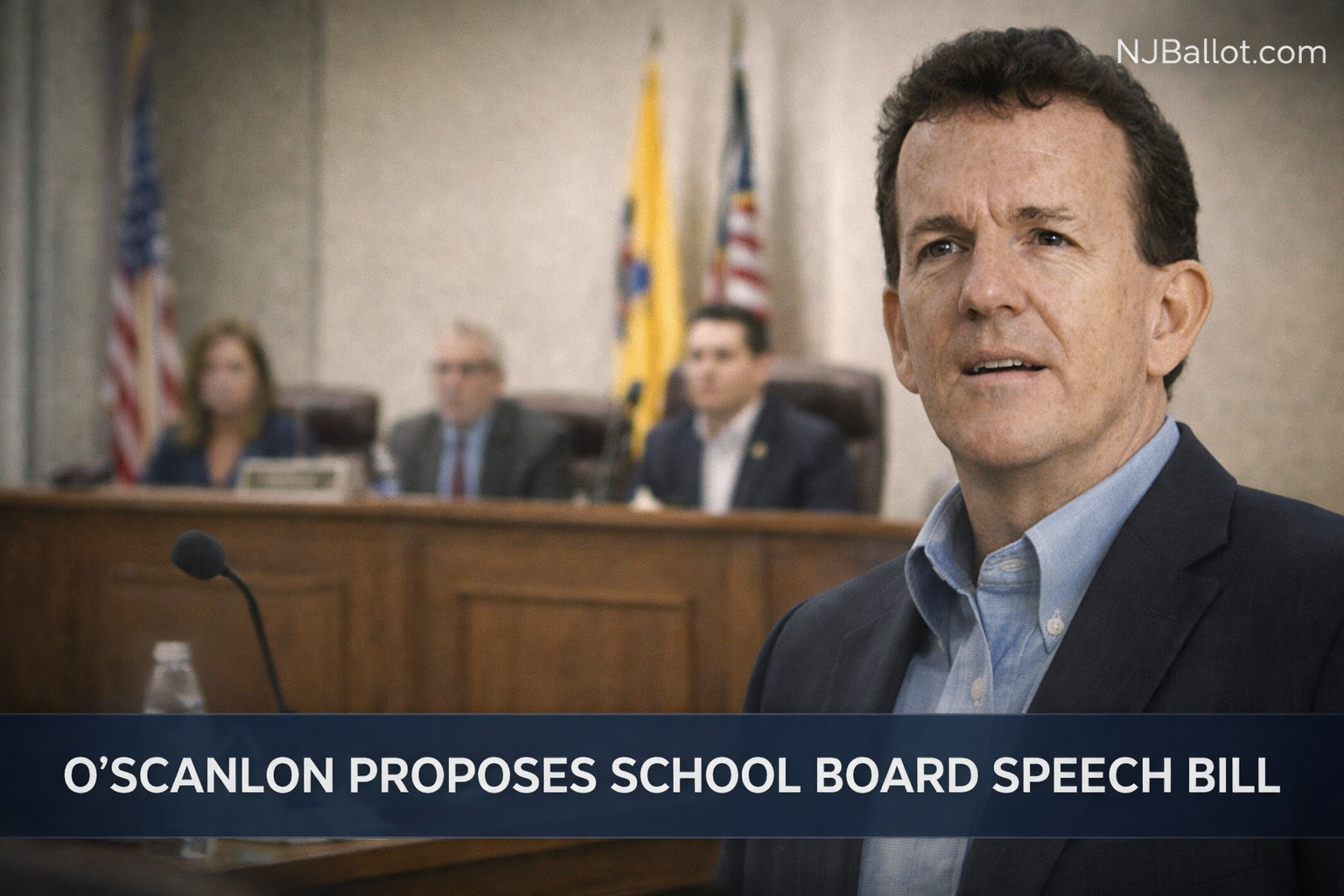
Now, her case has sparked legislative action. On April 14, 2026, State Senator Declan O'Scanlon (R-Monmouth) introduced S-4091, a bill that would bar sanctions against school board members for public speech on school matters, including social media.
"When we start telling elected officials they cannot speak openly with the very people they were chosen to represent, we're not promoting ethics, we're eroding transparency," O'Scanlon said in a statement announcing the bill. "My legislation makes it clear that school board members do not surrender their First Amendment rights when they take office."
The Warning
Nazarene's troubles began almost immediately after taking office in February 2025. At a March 20 township committee meeting, she spoke about the school budget. The board president later sent an email "reminder" about the School Ethics Act: specifically the requirement that board members speak with "one voice" once a decision is made. The precise timing of the email, whether immediately after the meeting or days later, is not specified in available records.
But the warning had its intended effect. When Nazarene posted about a potential 30% tax increase on March 30, she included a pointed disclaimer: "asking for myself AND ONLY FOR MYSELF---how do you feel about being silenced?"
By April 7, her frustration had boiled over into a public cry for help on X/Twitter: "My freedom of speech is being ripped away by the NJ school board...Help I need a lawyer."
The School Ethics Commission's interpretation of the law left no room for her kind of outreach. Under the commission's "nexus test," even explicit disclaimers are deemed "meaningless" if the substance of a post is "clearly linked" to board membership. The standard captures virtually any school-related speech by an elected trustee.
The Litigation
Represented by the Foundation for Individual Rights and Expression (FIRE), Nazarene filed a pre-enforcement challenge in federal district court on November 20, 2025. The lawsuit names Acting Commissioner Lily Laux; her predecessor Kevin Dehmer was originally listed as the defendant.
The complaint argues that New Jersey's School Ethics Act operates as a content-based restriction on political speech by elected officials, triggering strict scrutiny under the First Amendment. It cites Bond v. Floyd (1966), where the Supreme Court held that legislators must be given "the widest latitude to express their views on issues of policy."
A hearing on Nazarene's motion for preliminary injunction was held on February 17, 2026. Judge Christine P. O'Hearn has reserved the decision. The state's motion to dismiss was administratively terminated in February, after the Attorney General's office failed to comply with court filing requirements.
The Legislative Response
O'Scanlon's S-4091 represents the first legislative effort to curtail the School Ethics Commission's expansive interpretation of speech restrictions. The bill comes amid growing criticism that the 1991 School Ethics Act, originally designed to prevent conflicts of interest, has been applied in ways that silence dissent on policy matters.
The full text of S-4091 was not available in public legislative databases at time of writing. Specific statutory language and amendment details could not be independently verified.
The original sponsor of the School Ethics Act, former Assemblyman Anthony "Skip" Cimino, has acknowledged the drift from legislative intent. "It was never intended for us to effectively muzzle school board members," Cimino told NJ Spotlight News. "It was intended to stop the real corruption that was going on."
Yet the commission has developed an enforcement regime that NJSBA and First Amendment attorneys describe as unpredictable and speech-chilling. The New Jersey School Boards Association itself has reinforced these restrictions through training materials that advise members not to make Facebook posts expressing opinions, "even if you state comments are as[a] 'public citizen.'"
The School Ethics Commission did not respond to requests for comment on the legislation or the pending litigation.
O’Scanlon Faces Long Prospects
S-4091 faces long odds in the Democratic-controlled Legislature, where Democrats hold 24-16 majority in the Senate and 52-28 in the Assembly. The bill was introduced without Democratic co-sponsors. Governor Mikie Sherrill, who took office January 20, 2026, has not taken a public position on the legislation.
For Nazarene, the stakes are personal and immediate. She has stopped posting about a regionalization plan that she fears will eliminate local control of Alloway's schools. Those concerns are precisely the kind of constituent communication that an elected office is supposed to facilitate.
"I couldn't equate that asking questions of people would be equivalent to standing in the middle of a place and telling someone that the building is on fire," she said.
Whether the First Amendment agrees with her—and whether the Legislature or Governor will act before the courts decide—remains to be seen.
Sources
• Foundation for Individual Rights and Expression, "Lawsuit: New Jersey School Board Member Silenced After Asking Constituents About Tax Increase" (November 20, 2025)
• Foundation for Individual Rights and Expression, Nazarene v. Dehmer case page (accessed April 15, 2026)
• U.S. District Court for the District of New Jersey, Nazarene v. Dehmer, No. 1:25-cv-17770 (D.N.J. filed November 20, 2025)
• Nikita Biryukov, New Jersey Monitor, "Bill Would End Limits on School Board Member's Speech" (April 15, 2026)
• Insider NJ, "O'Scanlon Bill Would End Limits on School Board Member's Speech" (April 14, 2026)
• Press of Atlantic City, "Bill Would End Limits on School Board Member's Speech" (April 15, 2026)
• NJ Spotlight News, "Is the School Ethics Act Being Used to Muzzle Free Speech?" (January 6, 2026)
• Kenny Cooper, WHYY, "South Jersey school board member sues state over free speech restrictions" (November 20, 2025)
• New Jersey School Boards Association, workshop materials and training advisories (cited in New Jersey Monitor, April 15, 2026)
• Bond v. Floyd, 385 U.S. 116 (1966)