
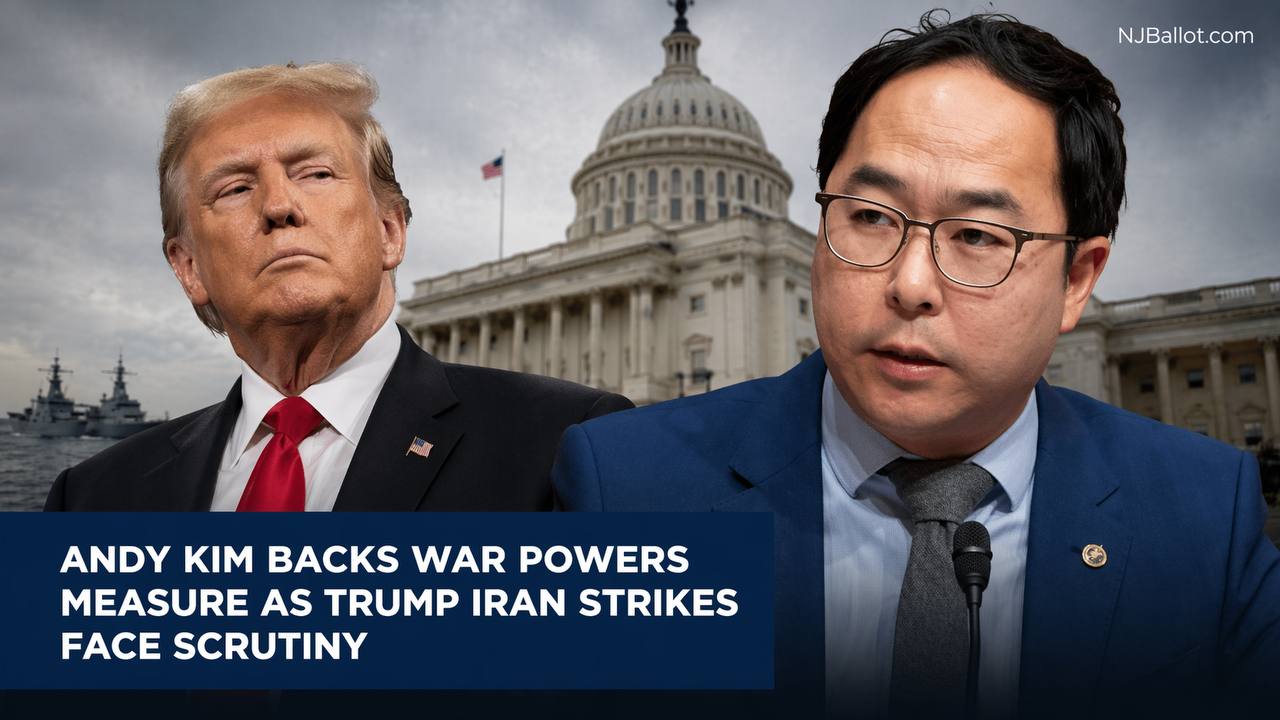

WASHINGTON, D.C.—U.S. Senator Andy Kim (D-NJ) is supporting a newly filed war powers resolution that could prompt a Senate vote on continued U.S. military operations against Iran.
The measure, introduced April 13 by a group of Senate Democrats, is expected to receive expedited consideration under procedures tied to the War Powers Resolution of 1973, allowing it to reach the Senate floor quickly.
Resolution Seeks Congressional Vote
The resolution follows a March 2 notification from the Trump administration to Congress confirming that U.S. forces, in coordination with Israel, conducted strikes inside Iran on February 28.
According to that notification, the strikes targeted ballistic missile infrastructure, air defense systems, maritime mining capabilities and command-and-control facilities. The administration stated the actions were taken to address security threats posed by Iran and to protect U.S. personnel, regional allies and international shipping routes, including the Strait of Hormuz, a critical global energy corridor.
Lawmakers supporting the resolution, including Kim, argue that Congress has not provided specific authorization for these operations and that lawmakers should vote on whether U.S. involvement should continue.
If approved, the resolution would direct the administration to end certain military activities unless Congress enacts authorization. Similar measures have historically faced legal and political challenges, including potential presidential veto.
Kim’s Public Statements
In public posts on social media, Kim has described the situation as a constitutional matter.
“Congress has not authorized this war,” Kim wrote in one statement. He added that lawmakers should vote before the United States becomes further involved in what he characterized as an “unconstitutional war.”
He also said the resolution aims to ensure senators take a public position on U.S. military engagement.
Prior Vote Highlights Division
The Senate previously considered a similar measure in March, which failed on a 47–53 vote.
That effort, like others before it, highlighted divisions in Congress over balancing national security decisions with legislative oversight. Voting largely followed party lines, with most Republicans opposing the resolution and most Democrats supporting it. One Republican, Sen. Rand Paul (R-KY), voted in favor in related efforts, while a few Democrats broke ranks in opposition.
Because the newly filed measure is considered privileged, it is expected to return the issue to the floor for another vote.
Administration Cites Security Justification
The Trump administration has maintained that the strikes and related operations fall within the president’s constitutional authority as commander in chief and were necessary to counter security threats.
In official statements, the White House has said the broader campaign is intended to:
• Degrade Iranian military capabilities, including ballistic missile systems;
• Protect U.S. forces and regional allies; and
• Maintain stability in global shipping routes and energy markets.
U.S. military officials have reported ongoing operations to secure maritime routes, including mine-clearing efforts in the Strait of Hormuz amid Iranian actions that disrupted commercial traffic. The administration has also imposed a naval blockade on Iranian ports and coastal areas to pressure compliance.
Broader Conflict and Regional Impact
The operations are part of the larger U.S.-Israeli military campaign against Iran that began on February 28 and dates back to last year's 12-Day War. The conflict has included strikes on military and government targets and resulted in reported military and civilian casualties on the Iranian side. The Department of War, formerly the Department of Defense, has not released U.S. casualty figures.
The U.S. State Department issued a worldwide caution alert, citing heightened risks to Americans abroad, and ordered the departure of non-essential personnel from several countries in the region.
Some lawmakers have requested further details from the Department of War on reports of civilian casualties linked to the strikes. Such reports in active conflicts are often disputed and have not been independently verified in full.
Iran has responded with actions affecting maritime activity, including efforts that closed or restricted access through parts of the Strait of Hormuz, raising concerns about global energy supplies and shipping disruptions.
New Jersey Connection and the Broader Context
Kim’s role places a New Jersey senator at the center of the national debate over war powers and foreign policy.
Before entering Congress, Kim served in national security and diplomatic positions, including at the State Department and National Security Council.
The issue reflects a longstanding constitutional tension between Congress and the president.
Article I of the Constitution grants Congress the power to declare war, while the War Powers Resolution of 1973 requires the president to notify Congress of military actions and limits extended engagements without legislative approval.
Supporters of the resolution argue that Congress must formally approve continued involvement. Opponents contend that the president needs flexibility to respond swiftly to emerging threats without prior congressional delay.
Subscribe to NJBallot.com for future updates.
Sources
• President Donald Trump, War Powers Notification to Congress (March 2, 2026)
• War Powers Resolution of 1973, U.S. Code
• U.S. Constitution Annotated, Article I, Section 8
• U.S. Senate Roll Call Vote 119-2-00069, Motion to Discharge S.J.Res. 116 (March 24, 2026)
• Jewish Insider, "Six more Democratic senators file new war powers resolutions to stop conflict in Iran" (April 13, 2026)
• Senator Tim Kaine, Press Release, "Senate to Vote on Iran War Powers Resolution Tomorrow" (March 3, 2026)
• The Hill, "Senate shoots down Iran war powers measure; Fetterman, Paul cross aisle" (March 24, 2026)
• CBS News, "Senate votes down effort to restrict Trump's Iran war powers" (March 18, 2026)
• TIME, "After Iran Strikes, Congress Confronts Its Limited Power Over War" (March 2, 2026)
• Senator Andy Kim, Press Release, "The Lasting and Disastrous Consequences of Trump's Unconstitutional War in Iran" (March 1, 2026)
• Lawfare, "White House Submits Iran War Powers Report to Congress" (March 3, 2026)
• Fox News, "Trump sends official notification to Congress on strikes against Iran" (March 2, 2026)