
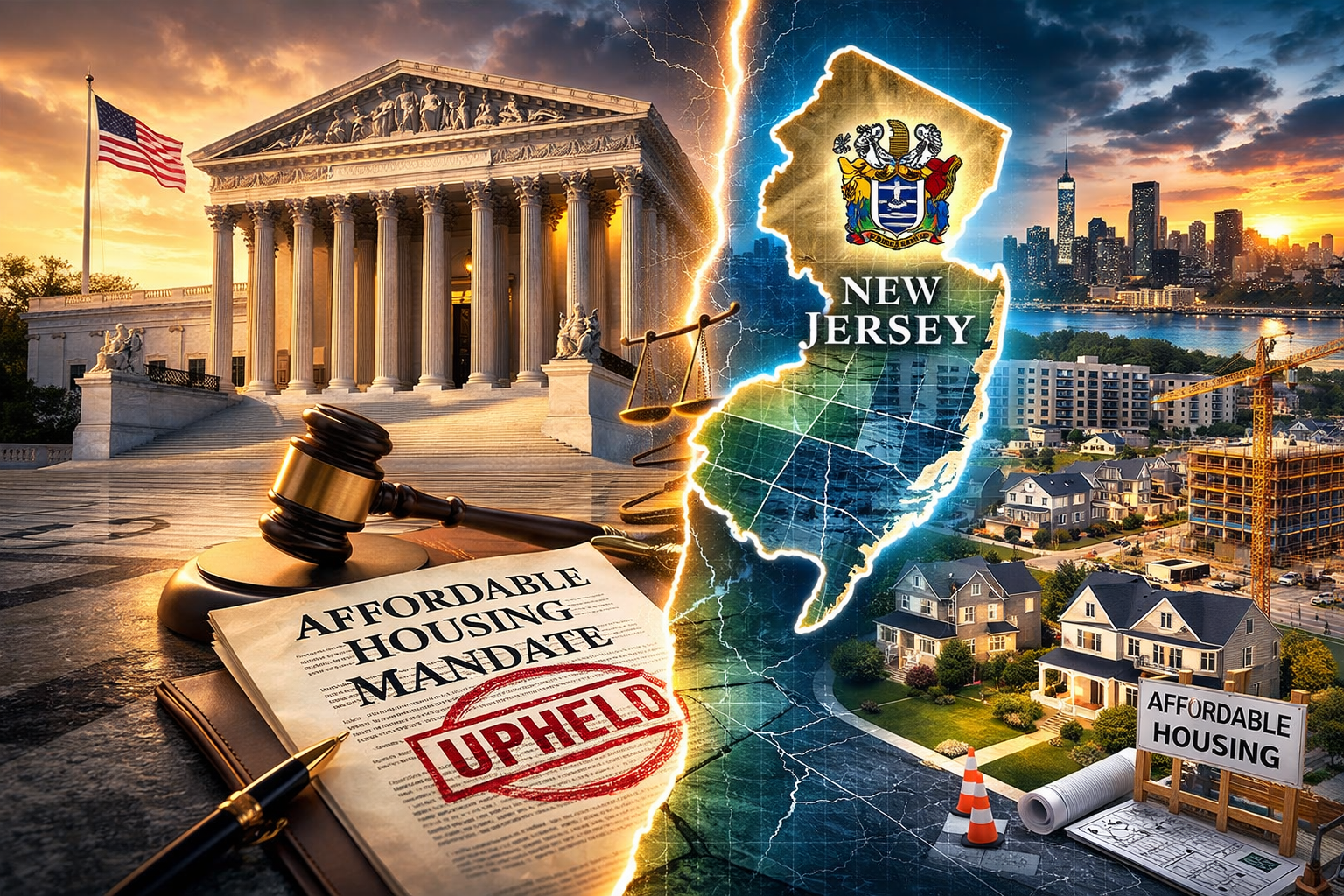

In a significant legal development, the U.S. Supreme Court has cleared the way for New Jersey’s affordable housing mandate to move forward, rejecting an emergency appeal from a coalition of municipalities seeking to halt the process. The ruling upholds a state law requiring towns to zone for their “fair share” of low- and moderate-income housing, a policy rooted in decades of New Jersey legal precedent.
The Ruling
On Feb. 24, 2026, U.S. Supreme Court Justice Samuel Alito, who handles emergency applications from New Jersey, denied the towns’ request for an emergency injunction. The brief order stated simply: “Application (25A898) denied by Justice Alito,” leaving in place lower court rulings that upheld the 2024 Affordable Housing Reform Law.
The decision means the March 15, 2026 deadline remains in effect. By that date, municipalities must adopt zoning changes to comply with their affordable housing obligations or risk losing immunity from “builder’s remedy” lawsuits, which allow developers to sue and force projects to bypass local zoning laws, if they include an affordable housing component.
The Challenge
A coalition of New Jersey towns and local elected officials, organized as Local Leaders for Responsible Planning, filed an emergency application with the Supreme Court on Feb. 9, asking Justice Alito to temporarily halt the March 15 rezoning deadline.
The towns argued the 2024 housing law unfairly burdens smaller communities while exempting larger “urban aid” municipalities from similar obligations. According to their application, “Only non-urban aid municipalities have a prospective need obligation. Urban aid municipalities are entirely exempt from any prospective need obligation and are not even required to satisfy the need generated by their own population growth.”
Local officials also raised concerns about the practical consequences of compliance. Montvale Mayor Mike Ghassali, a vocal critic of the state's Mount Laurel Doctrine on affordable housing, said the mandates force towns to accept high-density development that enriches developers without creating true affordability. Montvale, which has approximately 3,000 households, is required to make room for 350 affordable housing units by 2035.
“When most of the newly constructed one-bedroom apartments have rents for $4,000 a month, that is not affordability,” Ghassali said.
The towns further argued that requiring local elected officials to vote for zoning changes they oppose places them in a difficult political position, negatively affecting “their reputations as elected officials and prospects for re-election.”
The State’s Position
State officials and housing advocates welcomed the Supreme Court’s decision.
New Jersey Attorney General Jennifer Davenport, who was confirmed by the state Senate the same day as the ruling, issued a statement celebrating the outcome.
“Every level of the state and federal courts has now rejected this effort by a small group of towns and their officials to upend New Jersey’s landmark affordable-housing law. We look forward to continuing to defend New Jerseyans’ rights to affordable housing under our law,” Davenport said.
Assembly Speaker Craig Coughlin, D-Middlesex, a prime sponsor of the 2024 affordable housing law, said the mandate could create housing for 100,000 New Jersey families over the next decade.
“The courts have spoken clearly and consistently, and New Jersey families cannot afford further slowdowns in addressing our housing shortage,” Coughlin said.
Historical Context: The Mount Laurel Doctrine
This legal battle is the latest chapter in a fight dating back nearly 50 years.
The Mount Laurel Doctrine stems from a landmark 1975 New Jersey Supreme Court decision declaring exclusionary zoning unconstitutional and establishing that municipalities have an affirmative obligation to provide their region’s “fair share” of affordable housing.
The doctrine emerged from organizing and legal action by local NAACP branches and residents in South Jersey. It has since led to the creation of more than 75,000 affordable homes, including more than 25,000 since 2015. More than 400,000 New Jersey residents currently live in homes created under the Mount Laurel framework.
In March 2025, Gov. Phil Murphy commemorated the 50th anniversary of the ruling at the historic Jacob’s Chapel A.M.E. Church in Mount Laurel, joined by civil rights leaders and descendants of Ethel Lawrence, often called “the Rosa Parks of affordable housing.”
The 2024 Affordable Housing Reform Law, signed by Murphy, streamlined the development process and codified the methodology for determining each municipality’s obligations for the upcoming “Fourth Round” of housing quotas.
Current Challenges
Despite the legal victory, the state faces significant hurdles in meeting its housing goals.
An analysis by RentCafe.com found that between 2020 and 2024, New Jersey built 60,161 new apartments, but only 6.5% — 3,901 units — were fully affordable. Nationwide, approximately 12.6% of new apartment construction was affordable during the same period.
In 2024 alone, only 567 fully affordable units were built in New Jersey, compared with 91,000 units nationwide.
The state estimates that New Jersey will need to construct more than 80,000 affordable housing units by 2035 to meet projected needs.
With the Supreme Court’s denial, the focus now shifts to local implementation. Municipalities that meet the March 15 deadline may proceed with their housing plans and seek final court certification. Those that fail to comply risk builder’s remedy lawsuits, potentially resulting in court-ordered developments over local objections.
The decision does not end the legal debate over affordable housing in New Jersey, but it removes a significant roadblock to the current regulatory framework. As municipalities work to meet their obligations, the tension between local control and regional housing needs is likely to continue.
Sources
Courthouse News Service. “Small Towns Ask Supreme Court to Freeze New Jersey Rezoning for Affordable Housing.” February 9, 2026.
New Jersey 101.5. “Supreme Court Crushes NJ Towns’ Revolt Against Affordable Housing Mandate.” February 24, 2026.
Office of the Governor of New Jersey. “ICYMI: Governor Murphy & Lt. Governor Way to Speak at Historic Jacob’s Chapel to Honor Civil Rights Leaders.” March 24, 2025.
City of Summit, New Jersey. “Affordable Housing Update.” February 11, 2026.
New Jersey Future. “New Jersey’s Housing Landscape: The Mount Laurel Doctrine and the Search for the Missing Middle.” July 30, 2024.
Law360. “High Court Rejects NJ Towns’ Bid to Pause Housing Rule.” February 24, 2026.