
Executive Summary
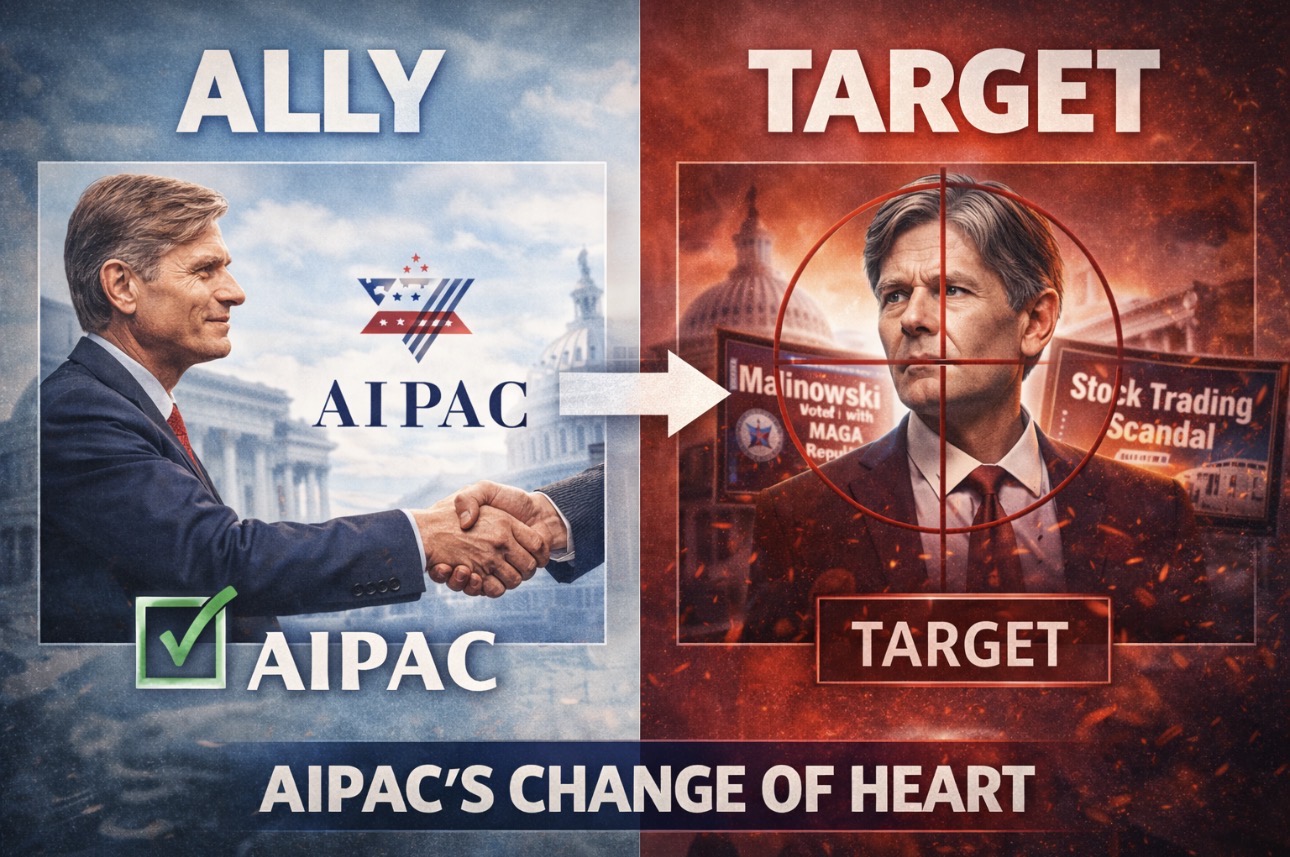
In a move that signals a sharper enforcement approach heading into the 2026 midterm cycle, political organizations aligned with the American Israel Public Affairs Committee (AIPAC), most notably its super PAC United Democracy Project (UDP), have launched an aggressive independent expenditure campaign aimed at blocking former Congressman Tom Malinowski’s return to Congress in New Jersey’s 11th District.
Despite previously supporting Malinowski during his 2022 reelection bid, AIPAC-aligned groups are now opposing his candidacy in the February 5 special primary. Based on available filings and reporting, outside spending opposing Malinowski totals approximately $4.13 million. This analysis finds that the intervention is not rooted in allegations of anti-Zionism, but rather in Malinowski’s public openness to conditioning U.S. military aid to Israel — a stance that appears to have crossed a newly enforced political “red line,” even for center-left Democrats.
The Numbers: A “Money Cannon”
As of February 4, 2026, United Democracy Project has saturated the NJ-11 media market. The scale of spending is notable given the compressed timeline of a special primary election.
- Total estimated outside spending opposing Malinowski: ~$4.13 million
- Estimated television advertising reservations: ~$2.3 million
- Direct mail, phone banking, and field operations: ~$1.83 million
- Spending classification: Independent expenditures (Super PAC), which legally prohibit coordination with any candidate
These figures are derived from a review of recent Federal Election Commission filings combined with reporting by The American Prospect.
For comparison, Malinowski’s own campaign has spent approximately $313,000 on advertising, placing him at a significant financial disadvantage in the final stretch of the race — an outspend ratio of roughly 13-to-1.
The Motive: The “Conditioning” Heresy
The pivot against Malinowski is explicit. Unlike prior primary targets in the 2024 cycle — such as Representatives Jamaal Bowman and Cori Bush — who were aligned with the progressive “Squad” and openly critical of Israeli government policy, Malinowski is a former Assistant Secretary of State and a mainstream Democrat who previously enjoyed AIPAC support.
The trigger appears to be Malinowski’s public statements expressing openness to conditioning U.S. military aid to Israel in order to ensure compliance with international law and broader U.S. strategic interests.
That position was directly addressed by Patrick Dorton, spokesperson for United Democracy Project, in comments to Punchbowl News:
“He talks about conditioning aid… That’s not a pro-Israel position, and he knows it.”
The remark suggests a narrowing enforcement standard for the 2026 cycle — one in which support for Israel as a state may no longer be sufficient absent unconditional backing of its government’s military policy.
The Tactics: Asymmetric and Pretextual Messaging
A defining feature of UDP’s intervention is the nature of its advertising strategy. While the apparent motivation for the spending centers on Israel policy, the content of the attack ads does not reference Israel or foreign policy.
Instead, the messaging is constructed to weaken Malinowski among key Democratic voting blocs through wedge issues.
Ad Narrative 1: “The ICE Attack” (Targeting Progressives)
- The claim: Malinowski “voted with MAGA Republicans” to increase funding for Immigration and Customs Enforcement.
- The context: The vote cited stems from a bipartisan 2019 omnibus funding bill used to keep the federal government operational — legislation supported by the vast majority of House Democrats at the time.
- The strategy: By framing Malinowski as aligned with Trump-era immigration enforcement, the ads aim to erode progressive support.
Ad Narrative 2: “Stock Trading” (Targeting Good-Governance Voters)
- The claim: Malinowski failed to properly disclose stock trades during the COVID-19 pandemic.
- The reality: The disclosure lapse was a legitimate ethics infraction that previously resulted in fines and public scrutiny, now repurposed as a central character attack.
The combined effect is to apply ideological pressure without revealing the foreign-policy rationale underlying the campaign.
The Field — and the Risk of Blowback
The scale of outside spending has reshaped the competitive landscape in NJ-11.
Former Lieutenant Governor Tahesha Way has received more than $1 million in outside support from Democratic-aligned organizations, positioning her as a well-funded alternative in the race.
However, some observers note a potential unintended consequence. By portraying Malinowski as aligned with ICE and conservative interests, the ads may push progressive voters toward Analilia Mejia, a candidate aligned with Bernie Sanders and Alexandria Ocasio-Cortez.
If Mejia were to consolidate progressive support, the outcome could prove ironic: millions spent to defeat a pro-Israel moderate potentially clearing a path for a candidate historically opposed by AIPAC-aligned organizations.
Malinowski’s Response
Malinowski has dismissed the advertising blitz as misleading and politically motivated.
“I have many pro-Israel supporters in the district who believe you can be passionately pro-Israel while still being critical of Netanyahu,” Malinowski said. “To say that they’re appalled by this campaign would be an understatement.”
Conclusion
The targeting of Tom Malinowski in NJ-11 represents a bellwether moment for the 2026 election cycle.
The intervention suggests that AIPAC-aligned political organizations are no longer focused solely on protecting incumbents or defeating ideological opponents. Instead, they appear willing to deploy substantial capital to discipline center-left Democrats who signal openness to conditioning U.S. military assistance.
Whether this capital-intensive strategy proves effective — or produces diminishing returns — will become clearer once voters cast their ballots on February 5.
Sources
Federal Election Commission filings
The American Prospect
Associated Press
Reuters
Punchbowl News
New Jersey Globe