
Executive Summary
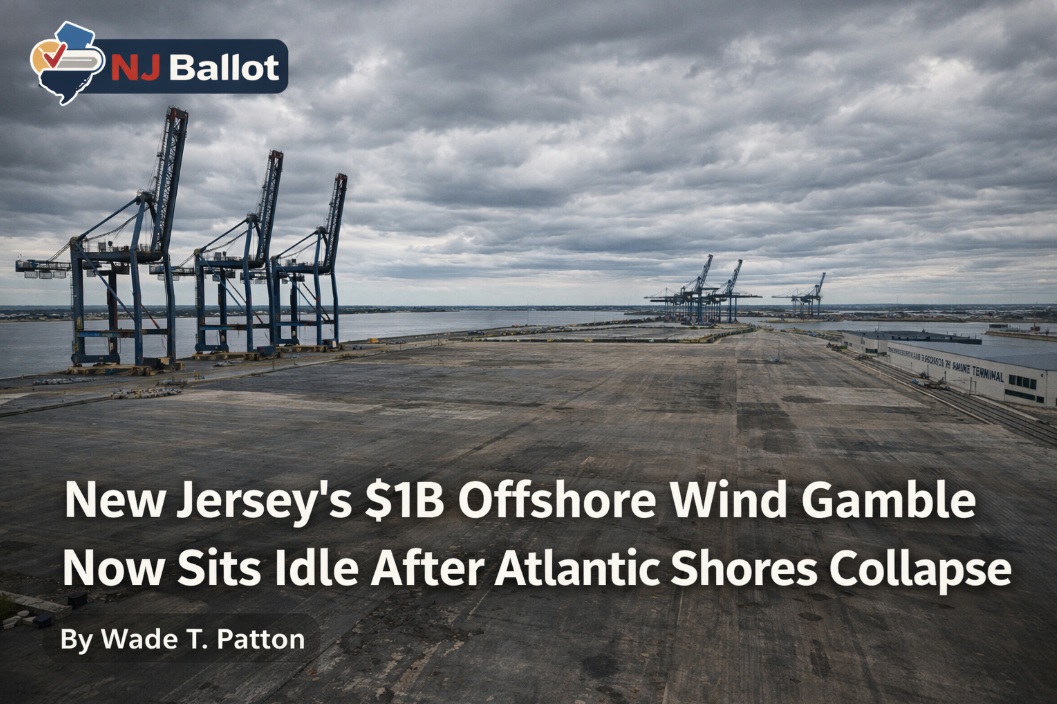
The "capital of American offshore wind" is currently a capital of empty infrastructure. Following the collapse of the Atlantic Shores deal in late 2025 and the cancellation of the state’s fourth solicitation, New Jersey’s $1 billion+ taxpayer investment in South Jersey ports now sits without a primary tenant. This report details the financial fallout of the state’s gamble on a sector now frozen by federal "stop-work" orders and corporate capital flight.
1. The Public Ledger: $1 Billion in Stranded Assets?
New Jersey taxpayers fronted the capital to build specialized ports for an industry that has largely evaporated from the state's pipeline.
The New Jersey Wind Port (Salem County)
Total Spent/Committed: ~$640 million (Phase 1).
Status: The port is operational but effectively dormant. Originally designed to marshal turbines for Orsted and Atlantic Shores, the facility has no active leaseholders moving commercial volume.
The Cost: The NJEDA issued $160 million in bonds and utilized $465 million in state funds (including debt defeasance monies) to build the site. With Atlantic Shores Project 1’s OREC contract terminated in August 2025, the revenue model for this port—relying on lease payments from developers—is currently broken.
Paulsboro Marine Terminal (Gloucester County)
State Investment: $250 million.
Current Reality: The monopile manufacturing facility, a partnership with EEW, faces a critical order book gap. While the facility was intended to supply the entire East Coast, the federal moratorium on new leasing and permitting (issued Jan 2025) has halted the project pipeline, leaving the state’s investment underutilized.
2. The Atlantic Shores Collapse
The primary driver of South Jersey's wind economy has disintegrated.
The Exit: Shell New Energies formally withdrew from the Atlantic Shores joint venture in early 2025, writing off approximately $1 billion in impairments.
Contract Termination: On August 13, 2025, the NJ Board of Public Utilities (BPU) voted to terminate the 2021 Offshore Renewable Energy Credit (OREC) Order for Atlantic Shores Project 1.
Ratepayer Impact (Corrected):
Previous Projection: Monthly bill increases starting in 2027.
Current Reality: The direct rate hikes tied to the Atlantic Shores contract are null and void. However, ratepayers effectively subsidized the administrative and legal apparatus for a failed procurement process. The risk has shifted from "future bill increases" to "wasted sunk costs" in the state budget.
3. Infrastructure: The "Bridge to Nowhere"
Larrabee Tri-Collector: The BPU previously awarded $1.07 billion (adjusted to ~$1.2 billion) for transmission upgrades to bring power ashore in Monmouth/Ocean counties.
Status: While engineering work proceeded throughout 2024, the cancellation of the generation projects renders this transmission capacity currently useless. It remains unclear if the state will attempt to claw back committed funds or pause the project indefinitely.
4. Jobs: From "Hibernation" to "Collapse"
The promise of 15,000 jobs by 2030 has been negated by market realities.
Manufacturing: The Paulsboro facility has not scaled to the 500+ permanent jobs originally promised.
Construction: The trade unions that signed Project Labor Agreements (PLAs) for Atlantic Shores have seen those potential hours vanish. The 2025 cancellation of the BPU's fourth solicitation means there is no immediate pipeline of work for South Jersey's heavy civil workforce in this sector.
5. Who Benefited?
While the projects failed, money still moved.
Consultants & Legal Counsel: Millions in soft costs were paid to firms managing the Environmental Impact Statements (EIS) and BPU applications between 2020 and 2025.
Landowners: Pre-development lease fees and option payments were made for various onshore parcels, money that remains with private landholders despite the lack of construction.
6. Official Responses
Governor Phil Murphy: The administration argues the port investments are "generational assets" that will be ready when the market eventually rebounds, blaming the current collapse on "hostile federal actions" from the new administration in Washington.
NJBPU: President Christine Guhl-Sadovy cited "uncertainty driven by federal actions" and Shell’s exit as the primary reasons for cancelling the fourth solicitation, effectively pausing the state's offshore wind program.
7. What South Jersey Residents Should Expect Next
Legal Battles: Expect litigation regarding the "clawback" of any state incentives already paid to developers, though most funds were tied to performance milestones that were never met.
Port Pivot: The NJEDA will likely face pressure to repurpose the Wind Port for other maritime uses (e.g., conventional shipping or defense) to generate revenue and service the debt.
No Immediate Construction: The threat of offshore construction visibility and local disruption is removed for the foreseeable future.
Sources
NJ Board of Public Utilities Order (Docket No. QO24020) – August 13, 2025
Shell PLC Fourth Quarter 2024 / First Quarter 2025 Earnings Report
NJEDA New Jersey Wind Port Financial Reports (FY2025)
Federal Register: Presidential Memorandum on Offshore Wind Leasing (Jan 20, 2025)
EPA Environmental Appeals Board Decisions (Air Permit Remand, March 2025)